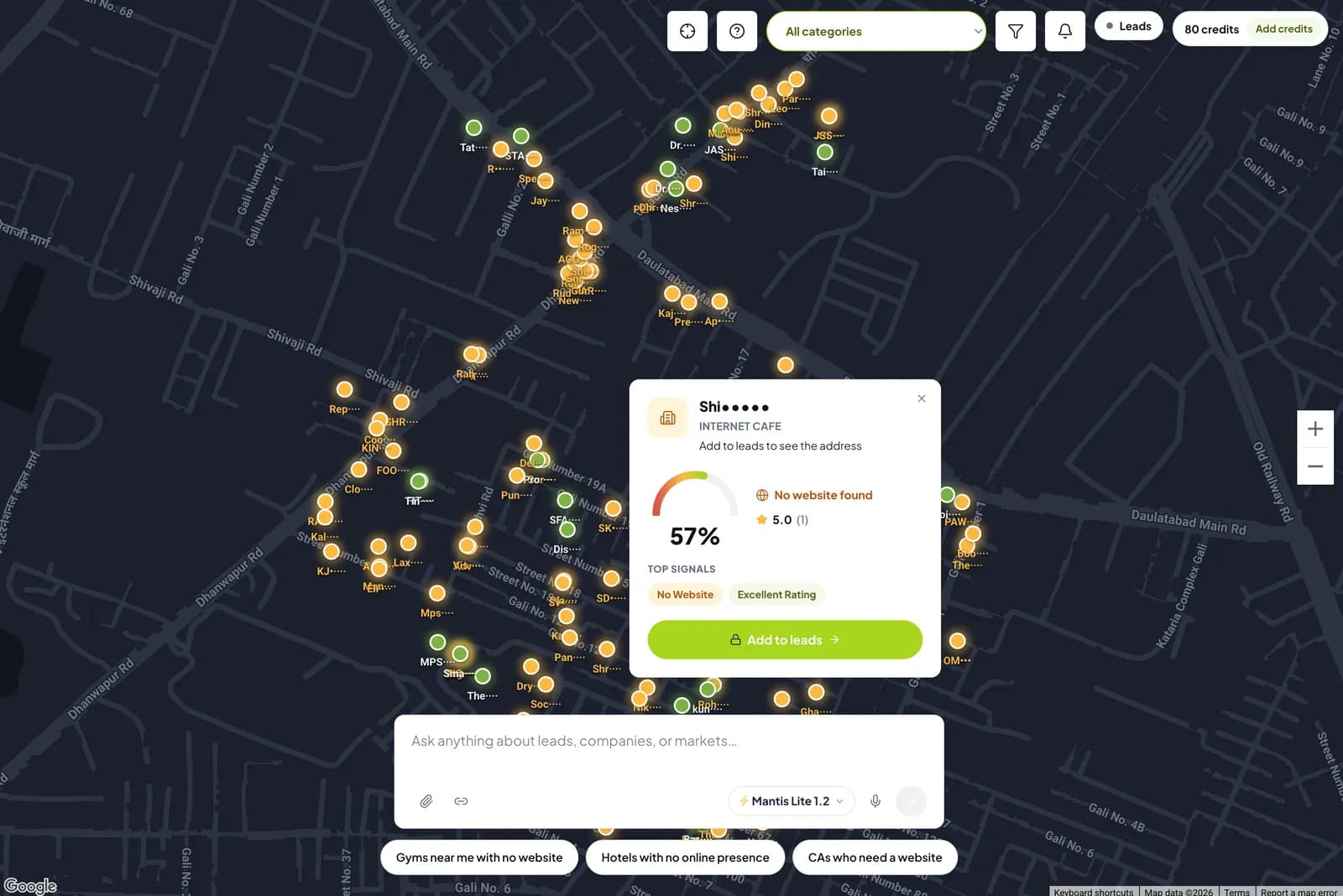
Live from our index, refreshed daily. Counts only include listings we have verified either way.
What people actually want from a Maps scraper.
Hardly anyone wants raw Maps data. They want a short list of businesses worth contacting this week.
Search for “google maps scraper” and you will find browser extensions, cloud actors and open-source tools that turn a Maps search into a spreadsheet. They work, and for a one-off export they are the cheapest way to get rows. The trouble starts after the export.
A raw scrape gives you every business in the search, including the ones that closed, the ones with three reviews from 2019, and the chains you will never sell to. It does not tell you whether the website field points at a real site or a Facebook page. It has no email addresses, because Maps listings do not carry them. And it is a photograph: the website field is exactly the one that changes when a business does the thing you were going to sell them.
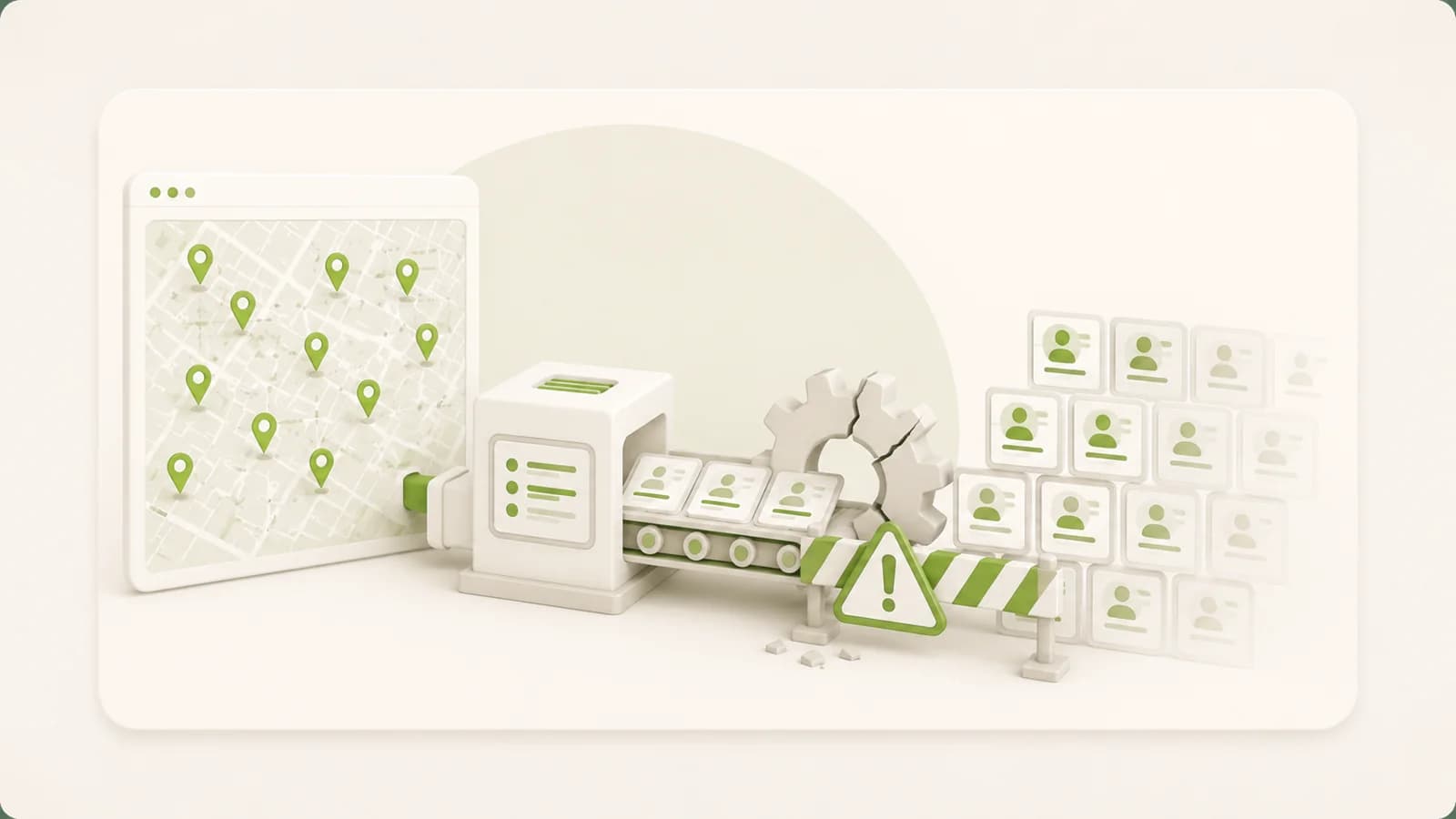
Mantis treats Maps as the starting point rather than the deliverable. Discovery comes from map listings; qualification comes from reading what each business has (or lacks) online; and the list you get is ranked by who is most worth a call.
How it works, step by step.
- 1
Describe the lead
Type the trade, the area and the filters in plain language: no website, review count range, rating range, trades to exclude. A neighbourhood, a city, a foreign city or all of India.
- 2
See the plan and the cost
Mantis shows what it will search and quotes the credits before anything runs. You tap Run; nothing is spent on a plan you did not approve.
- 3
Listings are pulled and de-duplicated
The area is split into small enough pieces to get past the per-search result cap, and repeats are removed by place identity rather than by name.
- 4
Each business is checked
Its website is read for contacts and signals — no HTTPS, not mobile-ready, old copyright year, no analytics, a social page used as a website, site down.
- 5
Leads land in your list
New businesses are added to Leads in a list named after the chat. Ones you already have cost nothing. From there you can run email and AI call campaigns.
Scraper versus Mantis, honestly.
Both start from the same public listings. They differ in what happens next and in who carries the maintenance.
| Mantis Ai | A typical Google Maps scraper | |
|---|---|---|
| Price per raw record | Higher — licensed data and per-lead credits | Lower — published rates around $1.50–4 per 1,000 places |
| Terms of service | Licensed map data | Scraping the Maps interface is against Google's terms |
| When Maps changes its layout | Nothing for you to fix | The scraper can break until its maintainer updates it |
| “No website” as a filter | Built in, and verified (a Facebook page counts as no website) | Usually a column you filter yourself |
| Emails | Read from the business's own site, graded Tier 1–3 | Not on the listing; extra enrichment step, often billed separately |
| Website signals | HTTPS, mobile, analytics, ad pixel, booking page, copyright year | Not included |
| Duplicates across overlapping searches | Removed by place identity | Yours to clean up |
| Output | Leads in Mantis, ready for email and AI call campaigns | A CSV or JSON file you own outright |
| CSV export | Not available yet | Yes — the whole point |
Scraper pricing from the vendors' published pages, summarised in our comparison of Maps scrapers. Prices change; check before you buy.
If you need ten thousand rows in a file tonight and you are comfortable with the terms risk, a scraper is the right tool and it will cost less. If what you need is fifty businesses worth phoning tomorrow, with the dead ones already removed and a reason to call each one, that is the job Mantis is built for. Below about fifty leads a week, doing it by hand in Google Maps costs nothing at all — here is how to do that well.
What each lead comes with.
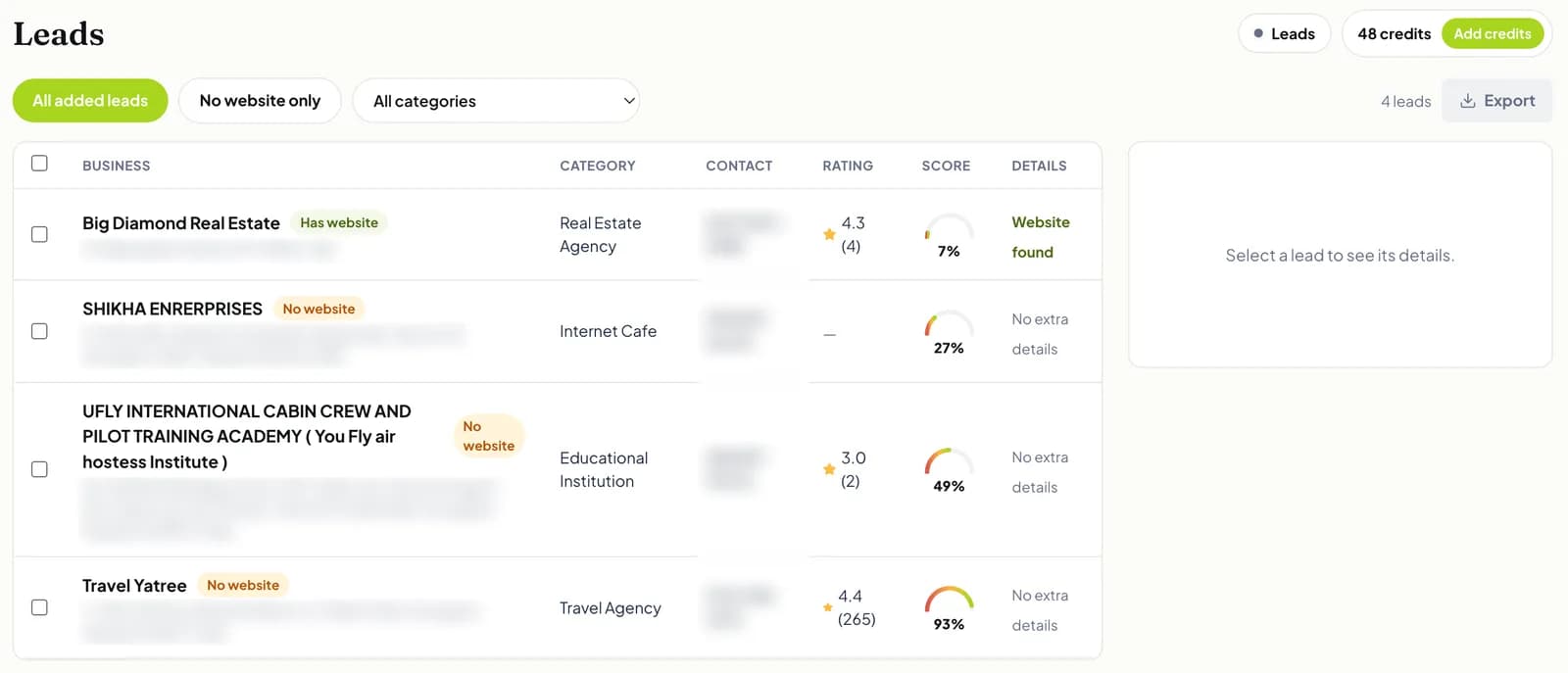
From the listing: business name, category, address, phone number, rating, review count, and whether it has a website of its own.
From its website, when it has one: emails graded by who they reach, phones graded mobile, landline or toll-free (with a WhatsApp link only for mobiles), the company LinkedIn, the founder or owner name where the site states it, and the signals you picked — no HTTPS, not mobile-ready, no analytics, no ad pixel, an online booking or menu page present or missing.
From the ranking: a heat score that weighs the gap you sell against with signs the business is trading. A no-website listing with eight reviews is usually dormant; one with four hundred is turning away online enquiries every week, and it is a completely different call.
Who uses it this way.
Web design agencies and freelancers
Businesses with an active listing, real reviews and no website at all — the most direct pitch there is.
Marketing and SEO agencies
Weak reviews, a low rating, no analytics or ad pixel, a site that is not mobile-ready: each is a reason to call.
Local B2B suppliers
Find every restaurant, clinic or hardware store in a territory, then let the AI voice agent ask who handles purchasing.
Sales teams entering a new city
Map a market before the first visit: how many businesses, which ones are busy, and who is reachable by phone.
Where it falls short today.
Worth knowing before you spend a credit.
Leads live in Mantis. If you need a file for another tool, a scraper or a manual export is the better route for now.
There is nowhere to read one from. You get the phone number on the listing, which for this segment is the channel that works anyway.
The owner's name appears only where the business's own site states it. Emails are graded but not bounce-verified.
Mantis finds businesses. It does not produce lists of individual people.
What it costs.
Once, at signup, with no card. Credits never expire. Finding leads and building or testing a campaign work on free credits; a paid plan is needed to launch campaigns.
A plan runs 30 days, never auto-renews, and unlocks bulk email campaigns, bulk AI voice calls and the campaign planner. Running short mid-month? Add funds from ₹50 at ₹1.25 a credit. No seats, no annual contract.
Full pricing and what each credit buys →Questions about Maps lead scraping.
Is Mantis a Google Maps scraper?
Not in the technical sense. It does not drive a browser over the Maps interface. It reads business listings through licensed map data, checks each business's website and public profiles, and keeps the results as leads you can filter and contact. The output is what most people want from a scraper — a list of local businesses with phone numbers, ratings and review counts — without the maintenance and terms-of-service risk of running one.
Is scraping Google Maps legal?
Scraping the Maps interface is against Google's terms of service. Whether that matters to you is a business decision rather than an engineering one, and it does not go away with better code. Licensed map data is the permitted route to the same listings, which is why it costs more per record than a scraper does.
How many results can I get for one search?
Google Maps itself shows a limited number of results per search (roughly 120), which is why scrapers have to split a city into many small areas. Mantis does that splitting for you: a run can cover a neighbourhood, a whole city, several cities or all of India, and it removes duplicates by place identity rather than by name.
Can I get email addresses from Google Maps?
A Maps listing does not carry an email address. Mantis reads the business's own website when it has one and grades the emails it finds: Tier 1 is a named person, Tier 2 a role inbox that reaches a decision (sales@, hello@), Tier 3 generic or support addresses. Businesses with no website usually have no email to find, and for those the phone number on the listing is the contact.
Can I find businesses on Google Maps without a website?
Yes, and it is the filter Mantis was built around. A business counts as having no website when its listing has none of its own; a Facebook page or Linktree in that field still counts as no website. The public lead pages on this site show how many verified no-website businesses there are by city and industry.
How much does it cost compared with a scraper?
Per raw record a scraper is cheaper, and we will not pretend otherwise. On Mantis, every account gets 500 free credits once; a live map lookup costs 2 credits past the free daily allowance, searching an area that has already been scanned is free, and each new lead added to your list is 5 credits. Paid plans start at ₹1,999 for 2,000 credits.
Can I export the leads to CSV or a CRM?
Not from the current leads view: CSV export and CRM connectors such as HubSpot, Zoho or Pipedrive are not available yet. Leads stay in Mantis, where you can run email and AI voice call campaigns against them directly. If a CSV file is the whole point for you, a scraper is the better fit today.