Live from our index. The gap between countries is the reason a lead finder that only reads websites misses most of the Indian market.
Where a lead finder looks decides what it finds.
Most lead finders search a database somebody built earlier, and that database is assembled from what is easy to crawl: company websites, professional profiles, email patterns. It works well for companies that live online. It quietly excludes the ones that do not — and in India that is a very large share of the market.
In our own index, 41.2% of Indian businesses checked have no website, against 18.1% in the US. A lead finder that starts from websites cannot see those businesses at all, however good its filters are.
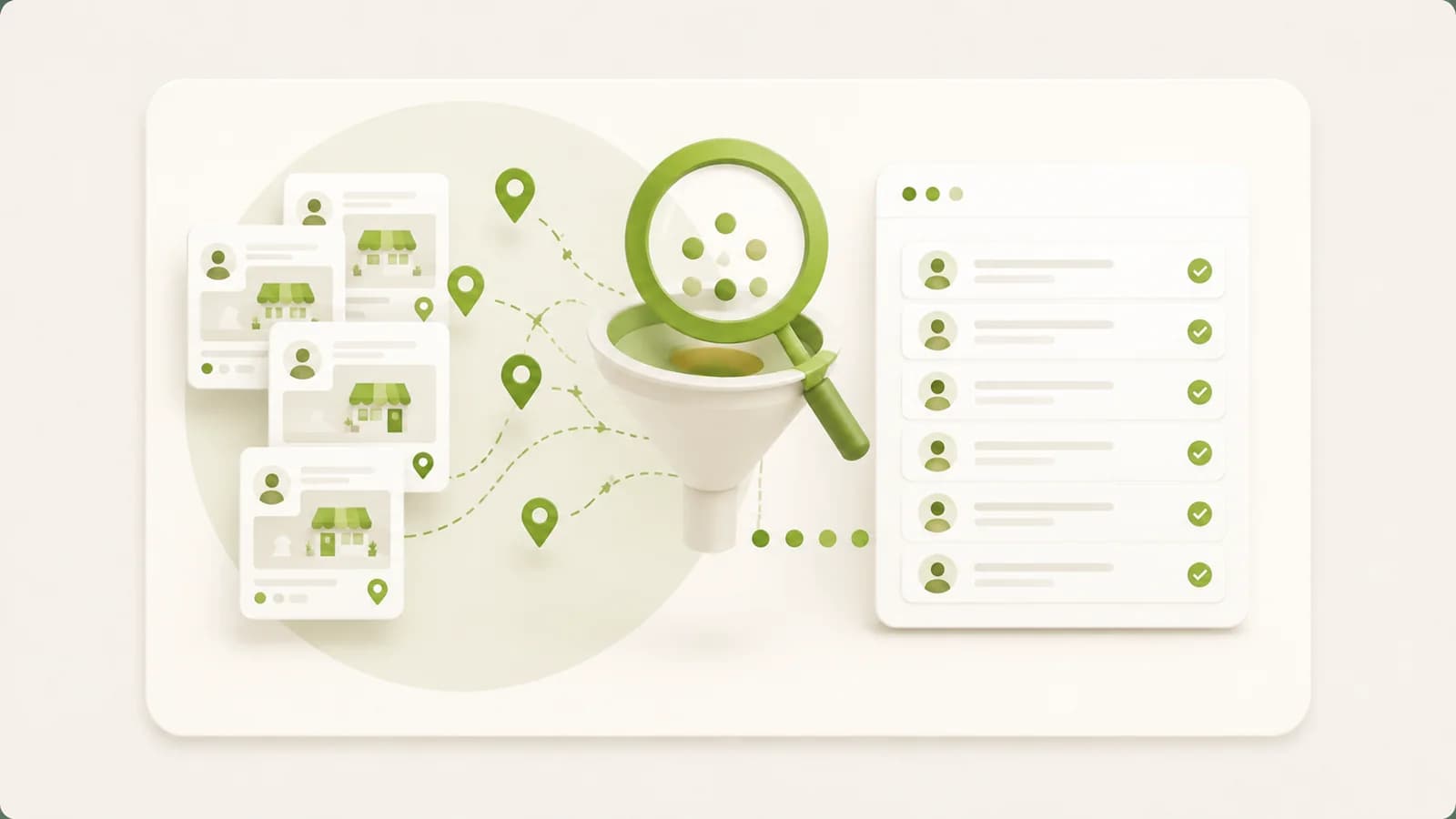
Mantis searches at the moment you ask, across the sources where each kind of business actually shows up: map listings for local trades, web search for companies that are not on maps, funding news for startups, public developer profiles for software teams.
Four ways to find leads.
Local businesses by trade and area
Gyms in Gurugram, tailors in Surat, plumbers in Leeds. From a neighbourhood up to all of India, with the no-website filter built in.
Companies that are not on maps
SaaS firms, importers, product companies and B2B services, found through web search and read from their own sites.
Startups that raised money
Funding round, amount and date, so you can reach a company in the months it is spending on new suppliers.
Developers and dev companies
From public developer profiles, for anyone selling tools, hiring or partnerships to software teams.
How to find leads with Mantis.
- 1
Say who you want
Trade or company type, place, count, and what makes them a fit: no website, a rating range, hiring now, several branches.
- 2
Pick the business profile
Tell Mantis what you sell — from your website or one line — so it can judge fit and size for your offer, not just keywords.
- 3
Check the plan
The scope and a credit quote appear before anything runs. Adjust the brief or tap Run.
- 4
Work the list
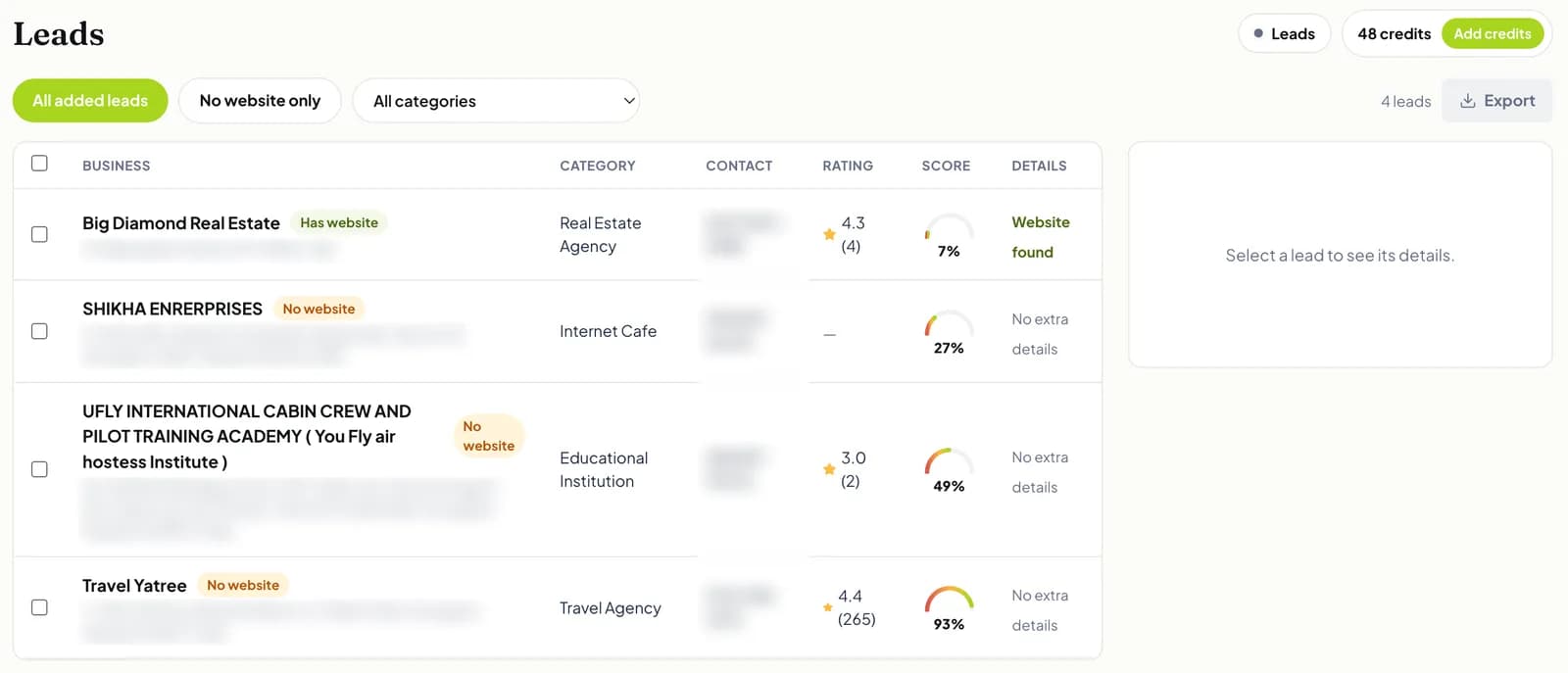
New leads cost 5 credits each; ones you already have are free. Each shows why it matched and how to reach it.
A good first brief is narrow. “Clinics in Gurgaon that don’t have a website” returns a list you can call this week; “all businesses in Delhi” returns a list nobody will finish. If you are not sure which niche to start with, the industries ranked by website gap is a useful place to look, and the chat will also answer strategy questions using our own coverage numbers.
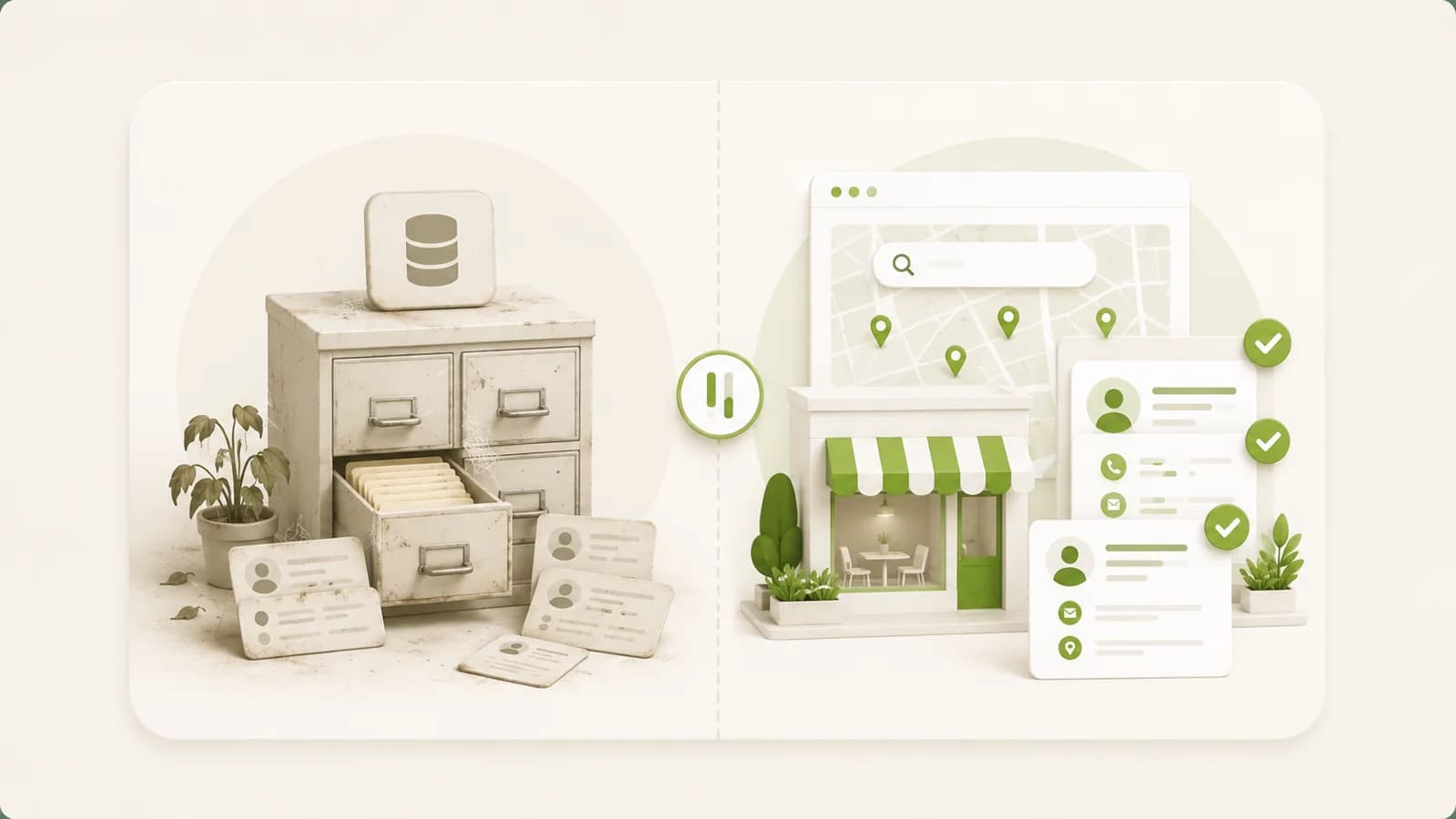
Live search versus a stored database.
| Mantis Ai (live search) | Database lead finder | |
|---|---|---|
| Small businesses with no website | Found — it is the core filter | Mostly absent |
| Freshness | Read when you search; already-scanned areas are re-used for free | As fresh as the last crawl |
| Named people at large companies | Only where a company's site names them | Broad coverage — their strength |
| Speed for a big list | Slower: each business is read | Instant: the rows already exist |
| Reason to contact | The matching signal on every lead | Usually firmographics only |
| Contacts | Phones on almost every local lead; emails graded Tier 1–3 | Verified emails and direct dials, varying by region |
| Next step | Email and AI voice call campaigns in the same tool | Export to a sequencer |
A database is the faster tool for large, well-documented companies. Live search wins where the businesses you want are not documented yet.
Before you sign up.
Mantis does not find individual consumers. For a consumer-facing business it suggests partners and suppliers to approach instead.
Owners appear only where the business's site names them, and emails are graded rather than bounce-checked.
New registrations (MCA, GST), RERA projects, ad libraries, Instagram last-post date and page-speed scores are not read today.
You work the list inside Mantis, with its own email and AI call campaigns.
What it costs.
Once, at signup, with no card. Credits never expire. Finding leads and building or testing a campaign work on free credits; a paid plan is needed to launch campaigns.
A plan runs 30 days, never auto-renews, and unlocks bulk email campaigns, bulk AI voice calls and the campaign planner. Running short mid-month? Add funds from ₹50 at ₹1.25 a credit. No seats, no annual contract.
Full pricing and what each credit buys →Lead finder questions.
What is a lead finder?
A tool that turns a description of your customer into a list of businesses you can contact. Some search a stored database of companies and people; others search live sources at the moment you ask. Mantis does the second: it searches map listings, the web, funding news and developer profiles, then reads each business's own website for contacts and signals.
How do I find leads for my business?
Start with one sentence that names the trade, the place and the reason they would buy: “restaurants in Indore with no online menu”, “logistics startups in Mumbai that raised money this year”. Then work a small list well before buying a big one. Fifty well-chosen businesses, each with a reason to call, beat five thousand rows nobody qualifies.
Can I find leads for free?
Yes, in two ways. The public lead pages on this site list verified businesses with no website by city and industry, free and without an account. And every new account gets 500 free credits once; at 5 credits per new lead that is enough to build and test a real first list.
Does the lead finder give emails and phone numbers?
Phones come from the business listing, graded mobile, landline or toll-free, with a WhatsApp link only for mobiles. Emails are read from the business's own website and graded: Tier 1 a named person, Tier 2 a role inbox that reaches a decision, Tier 3 generic or support. Businesses with no website usually have no email to find, so for them the phone is the contact.
Can it find leads outside India?
Yes. A run can target a foreign city as well as an Indian neighbourhood, a whole city or all of India. Coverage is deepest where we have scanned most, which the country table on our no-website pages shows openly.
Is it a B2B lead finder or for local businesses?
Both. Local businesses come from map listings by trade and area. Companies that are not on maps, such as SaaS firms, importers and product companies, come from web search. It finds businesses only, never individual consumers.