


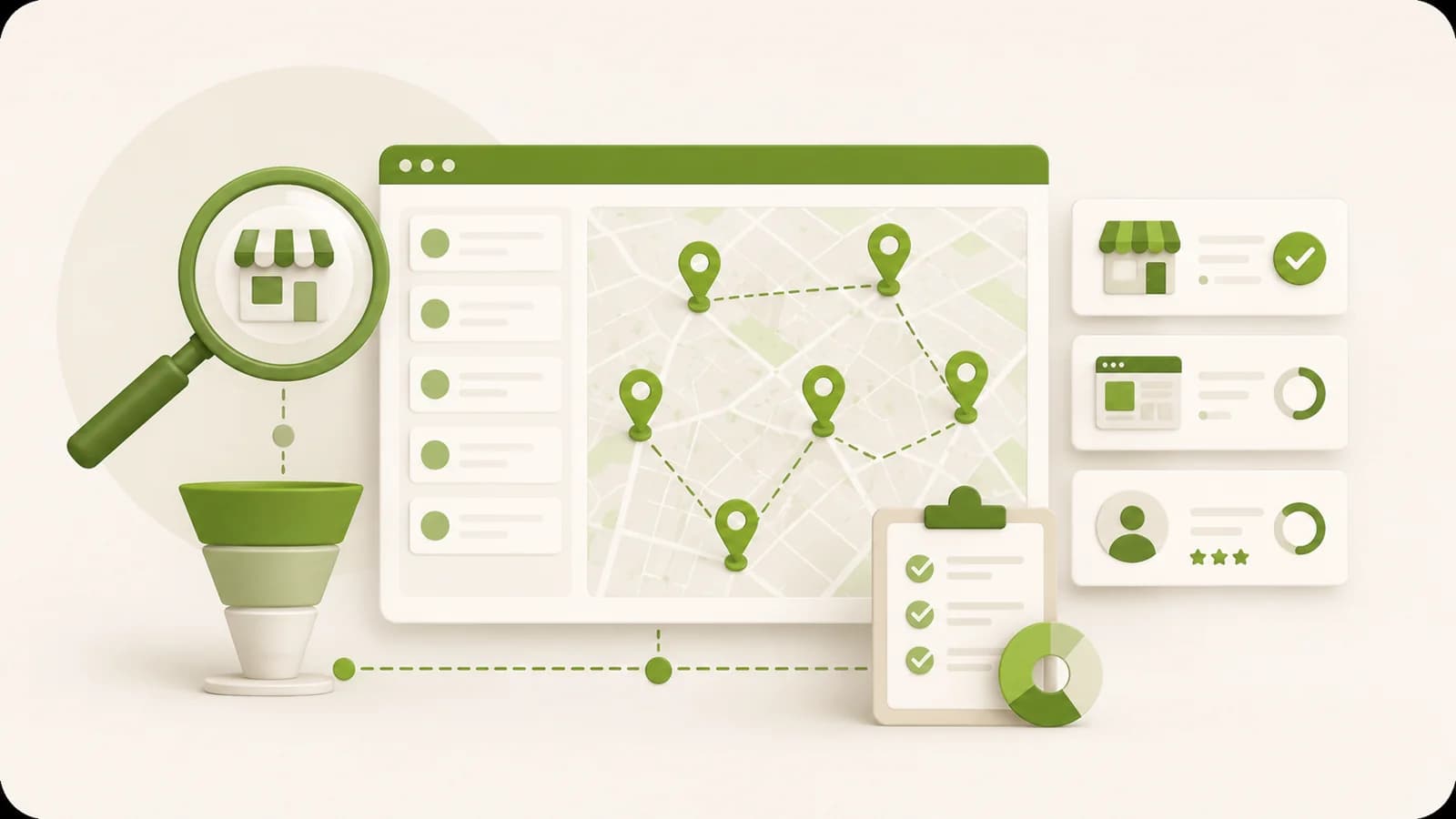
To find clients, decide exactly who buys what you sell, look for evidence that a business needs it now, go to the places those businesses are listed, contact them with a reason that is about them, and follow up more than once. That is the whole method. Everything else in this guide is practical detail about doing each of those five steps well for your kind of business.
Most advice on how to get clients skips the first two steps and starts at the third — here are twelve places to find leads — which is why so much of it produces long lists and short pipelines. A list of businesses is not a list of clients. The work that turns one into the other happens before the first message is sent.
This page is the hub for our client acquisition guides. It sets out the framework once, then splits by business type — agencies, professional services, software, manufacturers, wholesalers, exporters — with a link to the detailed guide for each.
The five-step framework for finding clients
Define who buys
One sentence naming the type of business, its size, its location and the problem you solve. If it fits ten thousand companies it is too loose; if it fits ten it is too tight.
Read buying signals
Something visible that says a business needs you now: hiring for a role you replace, no website, running ads with no tracking, a new branch, fresh funding.
Pick sources by business type
Local businesses live on maps and directories. Software and B2B companies live on the web, in funding news and on job boards. Importers live in trade data and fair catalogues.
Reach out with a reason
The first line names the signal you saw. The ask is small — a call, a sample, a quote — not a purchase.
Follow up on a schedule
Most replies come after the second or third touch, not the first. Decide the sequence before you start so you do not stop at one.
The order matters more than any single step. A sharp definition of the buyer makes the signals obvious; the signals tell you which sources to use; the signals also write the first line of the message; and a follow-up schedule is what converts the effort already spent into replies.
Step 1: define who buys before you find clients
An ideal customer profile sounds like a marketing exercise, but in practice it is a filter you can apply to a search. "Small businesses" cannot be searched. "Dental clinics in Pune with fewer than 30 Google reviews" can. "B2B SaaS companies in India that raised a seed round in the last year and are hiring their first sales rep" can.
Write the definition in four parts and test each one against a real search before you trust it.
If you already have a few clients, start from them. Look at the three best — paid on time, easy to work with, would buy again — and write down what they had in common before they hired you. That is a better profile than anything invented from scratch.
Step 2: look for signals, not just names
A signal is a fact you can observe from outside a business that makes it more likely to buy what you sell right now. It does two jobs: it ranks a list so you spend time on the likeliest buyers first, and it gives you something specific to say.
Different sellers need different signals. The table below lists the ones that are publicly visible and what each tends to mean.
| Signal | Where you see it | Who it suits |
|---|---|---|
| No website, or a social page used as one | The business's map listing | Web designers, local marketing |
| Hiring now, with role titles | Careers page, job boards | Recruiters, HR and payroll software, office fit-out, IT hardware, training |
| Raised funding recently | Funding news | Fundraising advisors, startup legal, virtual CFOs, B2B software |
| Running ads with no tracking | Ad libraries, the site's own code | Performance marketers, CRO and landing page work |
| Enquiry form that goes nowhere | The site's contact form | CRM, chatbots, WhatsApp automation |
| Several branches or a new one | Multiple listings, a locations page | Refrigeration, signage, POS, furniture, uniforms |
| Few reviews or a low rating | The map listing | Review management, local SEO |
| Exporter (IEC or export text on the site) | The website | Freight, customs, export finance |
| Old site, no HTTPS, not mobile-ready | The website | Redesign, maintenance, security |
Every signal here is something a stranger can check in under a minute — that is what makes it usable at scale.
One caution: an absent signal is weaker evidence than a present one. A map listing with no website field does not prove the business has no website, and a site with no booking link may still take bookings by phone. Treat absences as reasons to look closer, not as facts to quote back to the owner.
Start from the signal, not the list.
Describe who you sell to in plain language. Mantis finds the businesses, reads each website for the signals above, and pulls the contacts it states.
Find your first leadsStep 3: where to find clients, by business type
Where your clients are listed depends on what kind of business they are, not on what kind you are. A business that serves walk-in customers has a map listing almost by definition. A software company with no office worth visiting may have no listing at all, but it has a website, a careers page and probably a funding announcement.
| Your buyer is… | Where they are listed | Best first channel |
|---|---|---|
| A local business (clinic, salon, restaurant, shop) | Map listings, local directories | Phone, walk-in, WhatsApp |
| A professional firm (CA, law, architects) | Map listings, professional bodies, their websites | Phone, email to the partner |
| A B2B supplier or distributor | Map listings, trade directories, B2B marketplaces | Phone, then visit |
| A manufacturer | Websites, industrial cluster directories, trade fairs | Email with a spec sheet, then call |
| A software or tech company | Websites, job boards, funding news, developer profiles | Email, LinkedIn |
| An importer abroad | Trade data, fair exhibitor lists, export promotion councils | Email in their time zone |
Two things follow from that table. First, a single tool or database rarely covers all of it — sales databases are built from the web and miss businesses that have no website, while map data misses companies that never needed a storefront. Second, the channel follows the listing: a business you found on a map has a phone number far more often than an email address, so plan for the phone. Our piece on bought databases against live search goes into why the two kinds of source disagree.
Step 4: outreach that gets clients to reply
The first message has one job: earn a reply. It does that by being obviously about the recipient. A line that names the signal — "saw you are hiring two field sales reps in Indore", "your contact form on the services page posts to an address that bounces" — proves you looked, and it frames what you sell as an answer to something already happening.
Keep the ask small. A fifteen-minute call, a free sample, a quote for one item, a short audit. A request to buy in the first message gets ignored by people who would have bought after a conversation.
Match the channel to the buyer. Owners of small local businesses answer phones and WhatsApp; they rarely read cold email. Founders and managers of software companies live in their inboxes and on LinkedIn. Manufacturers and distributors expect a call and, past a point, a visit. Our comparison of calling, WhatsApp and walking in covers the local side in detail.
Step 5: follow-up, and the numbers to plan around
Most first messages go unanswered for reasons that have nothing to do with you: the owner was busy, the email went to a shared inbox, the call came during a delivery. A second and third touch, a few days apart and each adding something new, recover a large share of those. We wrote up how many touches a local business usually needs separately.
Plan your effort backwards from the number of clients you want. Your own reply and close rates are the only figures that matter, and you will not know them until you have run about a hundred contacts — so run a hundred, measure, and then size the list. As an illustration only: if one in ten contacts replies and one in five replies becomes a client, ten clients need five hundred contacts. If that number looks unmanageable, the fix is usually a sharper signal rather than a bigger list.
Put it on a calendar. The sellers who get clients consistently are rarely the ones with the best scripts; they are the ones who prospect at the same time every week. A weekly prospecting routine is worth more than any single campaign.
How to get clients, by business type
The framework does not change between industries. The definition, the signals, the sources and the channel do. These are the short versions, each with a full guide.
Agencies, marketing and tech services
Agencies have the richest set of signals, because the gaps they fix are visible on the client's own website: no tracking, no ad pixel, stale blog, missing SEO basics, weak social. Read the site, quote what you found, offer to fix one thing. See digital marketing leads, getting SEO clients, PPC leads, app development clients and managed IT and cloud clients; for web work, where to find web design clients.
Accountants, consultants and professional services
These buyers choose on trust, so referrals dominate — but triggers still exist: a new business, a company that has started hiring, a second branch. See accounting clients, bookkeeping clients, interior design clients, corporate training clients and recruitment leads.
Software and SaaS
Software buyers are found on the web, not on maps: through what their sites show (a booking page, a login, an enquiry form), what they are hiring for and whether they have raised. See CRM leads and, for the earliest stage, how to get your first 100 users.
Manufacturers, distributors, wholesalers and exporters
Physical-goods businesses sell into chains — brand to distributor to retailer, factory to OEM, exporter to importer — and each link has its own directories and trade events. See manufacturing customers, how to find distributors, wholesale customers, buyers for export and logistics clients.
Commercial services and creative work
Services sold to offices and venues win on reliability and contracts; creative work wins on a portfolio shown to businesses with an event, a launch or a weak visual presence. See commercial cleaning, pest control, catering, corporate travel, photography and graphic design.
How to get clients when you are starting from zero
With no clients, no case studies and no budget, the framework still holds — the sources just shift towards people who already know you. Your first customer almost always comes from your existing network or one introduction away from it; our guide to getting your first customer lays out that sequence.
After that, the question becomes volume without spending money. Getting leads without buying lists covers the free sources and what each costs in hours, and getting clients from LinkedIn is honest about where that channel works and where it wastes time. For the general process, start with how to generate leads and lead generation for small business.
The fastest test of a client definition
Search for twenty businesses that match it and read their websites. If you cannot say in one line why each of them would want what you sell, the definition is wrong — fix it before you write a single message.
Mistakes that cost the most time
Where Mantis fits in finding clients
Mantis does steps two to five for any seller. You describe who you sell to in a sentence; it finds the businesses — local ones from live map listings, and companies that are not on maps (software firms, B2B suppliers, importers, product companies) through web search, funding news and developer profiles. It reads each website for the signals in the table above, and pulls the contacts the site states: emails graded by how likely they are to reach a decision-maker, phones marked mobile or landline, the company LinkedIn and the founder's name where the site gives it.
From there, the Campaign Planner builds an email and AI voice-call sequence that you edit, test on yourself and approve before anything goes out. Mail goes from your own mailbox and a reply stops the sequence for that lead.
New accounts get 500 free credits, once. A new lead costs 5 credits, so that is enough for a real first batch to test a client definition against — which is the point. Our index has checked 393,117 businesses across 98 cities so far, but the number that matters is how many of your hundred reply.
Test your client definition on real businesses.
500 free credits at signup. Describe who you sell to and see who matches, with the signal and contact for each.
Start freeFrequently asked questions
How do I find clients for my business?
Write one sentence defining who buys (type, size, location, trigger), pick two or three visible signals that show a business needs you now, search the sources where that kind of business is listed, open with the signal you saw, and follow up at least twice.
What is the fastest way to get clients?
Your existing network, then businesses showing a clear buying signal right now. A short list of fifty businesses that are hiring, expanding or visibly missing what you sell will produce clients faster than a list of thousands chosen by category alone.
How do I get clients with no experience?
Start with people who already know you and ask for introductions rather than sales. Offer a small, fixed-scope first project at a fair price in exchange for a reference. One delivered result is worth more than any pitch.
Where can I find clients online for free?
Map listings for local businesses, company websites and careers pages for B2B buyers, funding news for startups, trade directories and fair exhibitor lists for manufacturers and importers, and LinkedIn search. All are free; what they cost is time.
How many people should I contact to get one client?
It depends on your offer and signal quality, so measure it: contact about a hundred businesses, record replies and outcomes, then size your list from your own rates. If the number needed looks too high, sharpen the signal before adding volume.
Is cold outreach still a good way to get clients?
Yes, when it is specific. Messages that name an observable reason to talk get replies; generic pitches sent at volume do not. Pair it with follow-up and the right channel for the buyer — phone for local owners, email and LinkedIn for software companies.
Related reading
Getting clients for an insurance agency · Getting customers for a printing business · Getting customers for a courier business · Getting clients for a construction company · Getting clients for an electrical contractor · Getting clients for a consulting firm · Getting clients for a security agency · Finding buyers for packaging · how to generate leads · lead generation for small business · getting leads without buying lists · customers for a manufacturing business · how to find distributors · finding buyers for export · customers for a wholesale business · your first 100 users · your first customer · clients from LinkedIn · digital marketing leads · SEO clients · PPC leads · app development clients · IT services clients · CRM customers · accounting clients · bookkeeping clients · interior design clients · corporate training clients · recruitment leads · logistics clients · commercial cleaning customers · pest control accounts · catering clients · travel agency clients · photography clients · graphic design clients · web design clients · a weekly prospecting routine