


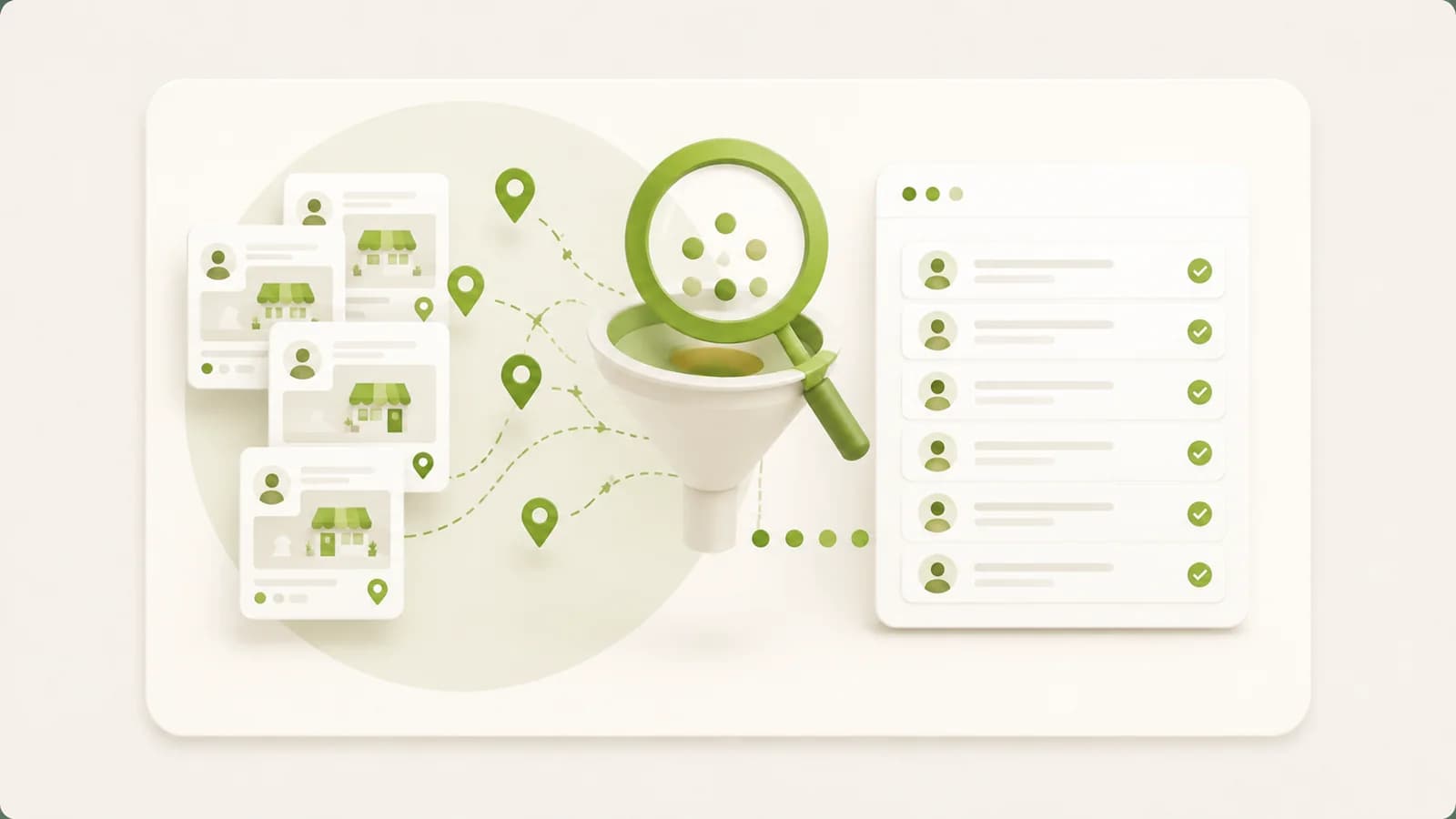
To generate leads for a small B2B business, define one type of buyer precisely, pick two signals that show a business needs you now, build a list of about a hundred businesses that show them, find a contact for each, and run a short multi-touch sequence — then review what replied every week. That process works with no marketing budget and no team, and it is the same one larger companies run with more people.
What changes when you are small is not the method but the constraint. You have a few hours a week, not a department. So the goal is not the most leads; it is the fewest leads that produce a client, which is a question of precision before volume.
What counts as a lead (and what does not)
Three words get used interchangeably and should not be. A contact is a business you could reach. A lead is a contact that fits your buyer definition and shows a reason to buy. A qualified lead is one that has replied and confirmed the need, the budget and who decides.
Most lead generation advice inflates the first into the second. A spreadsheet of five thousand companies in your industry is a contact list. It becomes leads only after a filter — and the filter is where small businesses can beat large ones, because you can afford to look at each business properly.
A seven-step process to generate leads
Write the buyer in one sentence
Type, size, place and trigger. 'Logistics companies in Pune with 20–200 staff that are hiring dispatch coordinators.'
Choose two signals
One that shows need (hiring, no tracking, a new branch) and one that shows ability to pay (team size, reviews, funding).
Build the first 100
From the source where that buyer is listed: maps for local firms, websites and job boards for B2B companies.
Find a contact for each
The website's contact page, team page and footer first; then the company LinkedIn for names.
Write a three-touch sequence
Touch one names the signal. Touch two adds proof. Touch three is a short close-the-loop.
Book conversations, not sales
The ask is fifteen minutes or a sample. Qualify on the call.
Review weekly
Which signal and which source produced replies? Do more of that next week.
The hundred is deliberate. It is small enough to research properly in a week of part-time work and large enough to tell you something: if a hundred well-chosen businesses produce no replies, the problem is the offer or the signal, and a thousand would only produce the same answer more slowly.
Picking signals that generate leads worth calling
A signal earns its place when it does two things: it raises the odds that a business buys, and it gives you a sentence to open with. "I noticed you are hiring a second accountant" is both. "I noticed you are a manufacturing company" is neither.
Good B2B signals are the ones a stranger can verify from outside: open roles on a careers page, a new branch listing, funding in the news, ads running with no conversion tracking, an enquiry form that does not post anywhere, a website that has not changed its copyright year in years. Weak signals are inferred ones — 'probably growing', 'looks outdated' — because you cannot quote them back to the buyer.
Match the signal to what you sell. A recruiter wants hiring. A CRM vendor wants lost enquiries. A fit-out firm wants expansion. Our hub on how to find clients has a fuller table of signals and the sellers each one suits.
Lead generation channels compared
There are only a handful of ways leads arrive, and each has a different time-to-first-result. A small business usually needs one fast channel to pay the bills and one slow channel that compounds.
| Channel | Time to first lead | Cost | Works best for |
|---|---|---|---|
| Your network and referrals | Days | Time only | Everyone, especially at the start |
| Signal-based outbound (email, phone) | Days to weeks | Time, or a tool | B2B services and software |
| Walk-ins and local visits | Days | Time and travel | Selling to local businesses |
| LinkedIn outreach | Weeks | Time; paid tiers optional | Selling to founders and managers |
| Content and search (SEO) | Months | Time | Topics buyers search for |
| Paid ads | Days | Budget | Offers with proven conversion |
| Marketplaces and directories | Days | Listing fees | Commodity products and services |
Time to first lead is the typical shape, not a measured figure; your own results will vary with the offer.
If you are small and need clients this quarter, signal-based outbound plus referrals is the combination to start with: it is fast, it costs time rather than money, and every conversation teaches you something about the buyer. Content is worth starting at the same time precisely because it is slow.
Using inbound and outbound to generate leads together
The two are usually presented as alternatives. For a small business they work best as one loop. Outbound conversations tell you the exact questions buyers ask and the words they use; those questions become pages and posts; the pages bring in a slow stream of inbound leads who already trust you a little; and the inbound leads show you which segment finds you on its own, which sharpens the next outbound list.
In practice that means one habit: after every sales call, write down the question that took longest to answer. Once a week, turn one of those into a short page on your site. After a few months you have a library of answers to real buyer questions, which is both your best inbound asset and your follow-up material — the second touch of a sequence is far stronger when it links to a page that answers an objection before the buyer raises it.
Referrals sit in the same loop. Every client you won through outbound is a source of introductions to similar businesses, and introductions convert better than any cold channel. Ask at the point of delivery, when the result is fresh, and ask for a specific type of business rather than 'anyone'.
Generate the first hundred leads in one sitting.
Describe the buyer and the signal. Mantis finds the businesses, reads each website and pulls the contacts it states.
Try it freeFinding the right contact
For a small company, the owner or founder is the buyer, and their name is often on the About or Team page. For a larger one, find the function head — operations, HR, marketing — on the company LinkedIn page.
Email addresses are not equal. A named address (priya@) reaches a person. A role address such as sales@ or hello@ at a small business usually reaches the owner too. info@ or support@ at a large company reaches a queue. Phone numbers have the same hierarchy: a mobile gets the owner; a landline gets the front desk.
Do not guess email patterns and send to them at volume. Unverified guesses bounce, and bounces damage the reputation of the mailbox you depend on. Use what the business publishes, and use the phone when it publishes nothing else.
The sequence that turns leads into conversations
Touch one names the signal and makes a small offer: "Saw the two dispatch roles on your careers page. We place dispatch coordinators for logistics firms in Pune, usually within two weeks. Worth a 15-minute call this week?"
Touch two, three or four days later, adds something useful — a short example, a number from your own work, a relevant observation. Not "just bumping this".
Touch three, a week after that, closes the loop politely and leaves the door open. A surprising share of replies arrive here, because it removes pressure.
Use a second channel inside the sequence where it fits: a call after the second email for a business that publishes a phone number, or a LinkedIn connection to the founder you emailed. Our post on how many touches a business needs goes deeper on spacing.
Keep a three-column log
Business, signal used, outcome. After a hundred contacts you will see which signal produced replies — that one line of insight is the most valuable output of your first month of lead generation.
Where small-business lead generation goes wrong
How Mantis helps generate leads
Mantis is built around the process above. You describe the buyer in plain language; it plans a run, shows you the scope and the credit cost, and on approval finds the businesses — local ones from live map listings, and companies that are not on maps through web search, funding news and public developer profiles.
Each lead comes with the signals read from its own website (hiring with role titles, missing tracking, an enquiry form that goes nowhere, branches, and more), emails graded by how likely they are to reach a decision-maker, phones marked mobile or landline, the company LinkedIn and the founder's name where the site states it. The Campaign Planner then drafts an email and AI voice-call sequence that you approve before it runs.
New accounts get 500 free credits once, and each new lead costs 5 — enough to run the first-hundred test from this guide. Building the same list by hand is covered in how to get leads without buying lists.
Run your first hundred on free credits.
500 credits at signup, no card. See the signal and the contact for every lead before you write a word.
Start freeFrequently asked questions
What is the best way to generate leads for a small business?
Referrals plus signal-based outbound. Define one buyer precisely, find a hundred businesses showing a reason to buy now, contact each with a message that names that reason, and follow up twice. It costs time rather than budget and teaches you the buyer quickly.
How do I generate B2B leads without a budget?
Use free sources: company websites and careers pages, map listings, funding news, trade directories and LinkedIn search. Research a hundred businesses yourself, find published contacts, and run a three-touch sequence from your own mailbox.
How many leads do I need to get one client?
It depends on your offer and how precise your signal is, so measure it rather than guess. Contact around a hundred well-chosen businesses, count replies and clients, and use your own rates to plan the next list.
What is the difference between a lead and a prospect?
Usage varies, but a useful split is: a contact is any business you could reach; a lead fits your buyer definition and shows a reason to buy; a qualified lead or prospect has replied and confirmed need, budget and who decides.
Is cold email still effective for lead generation?
For B2B buyers who work from an inbox, yes, when the message is specific and the address is real. It works poorly for local owners who live on the phone, and guessed addresses that bounce will damage your mailbox's reputation.
Related reading
the client-finding framework · a weekly lead generation system · free lead sources · bought databases against live search · how many touches it takes · building a lead list