


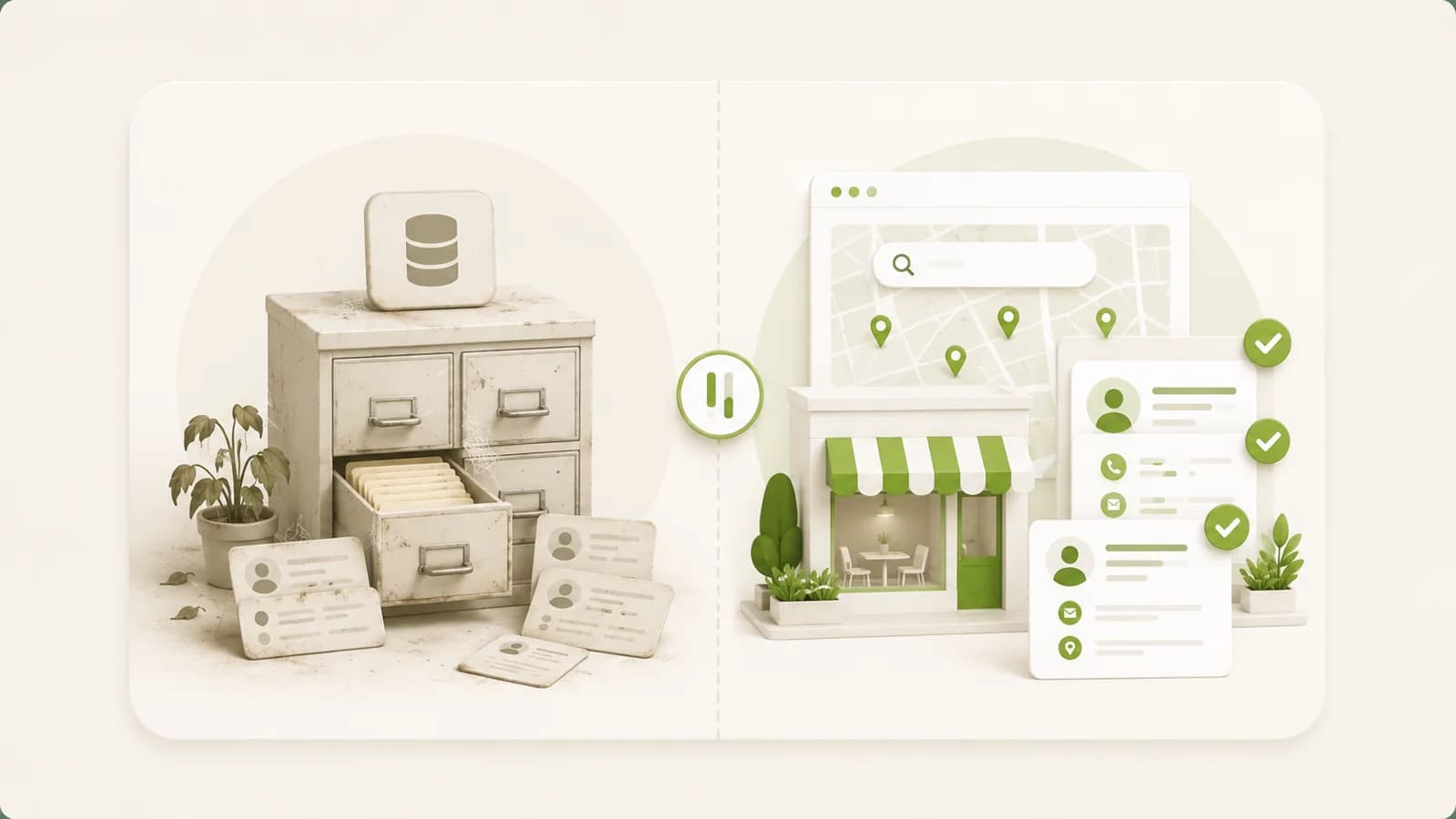
You can get leads without buying lists by building them from public sources yourself: map listings for local businesses, company websites and careers pages for B2B buyers, funding news for startups, trade directories and fair exhibitor lists for manufacturers and importers, and LinkedIn for names. None of it costs money. All of it costs time, and the skill is spending that time on the sources that match your buyer.
A self-built list also tends to be better than a bought one, for a reason that has nothing to do with price: you know why every business is on it.
Why bought lists underperform
A purchased list has three structural problems. It is shared — whoever sold it to you sold it to others, so the businesses on it hear the same pitch repeatedly. It is dated — companies move, close and change staff, and the list was compiled before you bought it. And it is selected by category, not by need, so it tells you who a business is but not why it would buy now.
There is a fourth problem specific to local markets. Most sales databases are built by crawling the web, so a business without a website barely exists in them — and in many local categories that is a large share of the market. We covered that in detail in why bought databases and live search disagree and exclusive leads against your own list.
Free sources to get leads, and what each gives you
| Source | Best for | What you get | Time cost |
|---|---|---|---|
| Google Maps and map listings | Local businesses, suppliers, clinics, shops | Name, phone, address, rating, website if any | Low per lead, but manual |
| Company websites | Any B2B buyer | What they sell, team names, emails, signals | Medium — you have to read |
| Careers pages and job boards | Sellers to growing companies | Open roles, which reveal budget and needs | Low |
| Funding news | Selling to startups | Round, amount, date, founders | Low |
| LinkedIn search (free) | Finding decision-makers | Names, titles, company size | Medium; limits on free search |
| Trade directories and B2B marketplaces | Manufacturers, suppliers, distributors | Product categories, contact numbers | Low, but listings are shared |
| Trade fair exhibitor lists | Manufacturers, exporters, importers | Companies active in a sector this year | Low |
| Industry associations and chambers | Professional and industrial buyers | Member lists, sometimes with contacts | Varies |
Time cost is relative. Reading websites is the slowest step and also the one that produces the signal you open with.
The pattern to notice: the fast sources give you names, and the slow source — reading the business's own website — gives you the reason to call. Skip that step and you are back to a category list, just a free one.
A no-budget method to get leads in a week
Write the buyer and two signals
Who buys, and what visible fact shows they need it now.
Pull 50 names from the fastest source
Map listings for local buyers; a job board or funding news for B2B.
Read each website for five minutes
Confirm the signal, find the decision-maker's name, note the best published contact.
Cut to the best 30
Drop anything without a clear signal or a reachable contact.
Contact and follow up
First touch names the signal; two follow-ups over ten days; call where a phone is published.
Thirty well-chosen leads a week is a realistic pace for one person doing it part-time. That is enough to learn whether your offer lands, which is the real purpose of the first month.
Free signals hiding in plain sight
The most useful buying signals are public and free to read. You only have to know where to look.
Same method, without the five minutes per website.
Mantis reads each business's site for these signals and the contacts it publishes. 500 free credits at signup.
Try it freeGetting contacts without paying for data
Start with what the business publishes: the contact page, the footer, the team page, the Google listing. Small businesses usually publish the owner's mobile or a role inbox that reaches the owner. Larger ones publish a switchboard and sometimes named staff.
For names, the About page and the company LinkedIn page are the best free sources. Pair a name with a role inbox or a phone call — "Could I speak to Anil about the dispatch roles you posted?" — rather than guessing an address.
Avoid guessing email patterns at volume. Unverified guesses bounce, and a mailbox that bounces a lot gets filtered, which costs you far more than a data subscription would.
A worked example: getting leads for an HR consultancy
To make the method concrete, take a two-person HR and payroll consultancy in Pune with no marketing budget. Its buyer: companies with roughly 20 to 200 staff that are growing fast enough to outgrow spreadsheets and an informal HR function.
The signal is hiring. A company advertising several roles at once is adding headcount, and headcount is what makes payroll, compliance and onboarding painful. A second signal for ranking is a careers page with no structured hiring process — roles posted as images, or a 'send your CV to' address.
The source is job boards and company careers pages, searched for Pune and filtered to companies posting three or more roles. That produces a few dozen names in an hour.
The research is five minutes per company: confirm the roles on the company's own site, find the founder or operations head on the About page or company LinkedIn, and note the best published contact. Companies without a reachable person get dropped.
The outreach opens with the signal: "Saw you have five open roles in Pune right now — at that pace, payroll and onboarding usually start taking a founder's evenings. We run both for companies your size. Worth a short call?" Two follow-ups over ten days, one of them adding a short checklist on onboarding compliance.
None of that cost money, and every lead on the list has a reason to talk. That is the difference a self-built list makes.
When paying for leads starts to make sense
Free is free in money and expensive in hours. The point to pay is when your hour is worth more than the cost of doing the same work with a tool — and when you already know which signal works, so you are paying to scale something proven rather than to explore.
Rough rule: if building and researching a lead by hand takes you five minutes and your time is worth more than a few hundred rupees an hour, a tool that does it for a few rupees per lead pays for itself on the first list. Before that point, doing it by hand is the education.
What to pay for matters too. Paying for a live search that reads current websites is different from paying for a static list, for the reasons above. Our comparison of credit-based and seat-based tools covers how pricing models change the maths.
Keep the free habit even after you pay
Reading five websites by hand each week keeps you close to what buyers actually look like. Sellers who outsource that entirely tend to drift into generic messaging.
Getting leads with Mantis on free credits
Mantis does the method in this guide end to end: you describe the buyer, it searches live map listings and the web, reads each website for signals, and returns businesses with graded emails, phones marked mobile or landline, the company LinkedIn and the founder's name where the site states it.
New accounts get 500 free credits once, with no card. A new lead costs 5 credits, and a business you already have is free, so a first list to test your signal costs nothing. For the full client-finding framework, see how to find clients; for the do-it-yourself version of map searching, free ways to find businesses.
Get your first leads without buying a list.
Live search, signals read from each website, contacts the business publishes. Free credits at signup.
Start freeFrequently asked questions
How can I get leads with no money?
Build lists from public sources: map listings for local businesses, company websites and careers pages for B2B buyers, funding news for startups, and trade directories for manufacturers. Read each website for a buying signal and use the contacts it publishes.
Is it better to buy leads or build your own list?
Build your own first. A self-built list is current, selected by need rather than category, and not shared with competitors. Paying makes sense once you know which signal works and your time is worth more than the tool's cost per lead.
Where can I get free B2B leads?
Company websites, careers pages and job boards, funding news, LinkedIn search, trade fair exhibitor lists, industry associations and B2B marketplaces. The website itself is the most valuable because it shows the reason to buy.
How do I find someone's email without paying?
Use what the business publishes: contact page, footer, team page and Google listing. At a small business, a role inbox like hello@ usually reaches the owner. Avoid guessing patterns at volume, since bounces damage your mailbox.
How many leads can one person build by hand in a week?
Working part-time and reading each website properly, around thirty well-researched leads a week is a realistic pace. That is enough to test whether an offer and signal work before spending money on scale.
Related reading
how to find clients · bought databases against live search · exclusive leads against your own list · free ways to find businesses · how lead tools charge · how to generate leads