


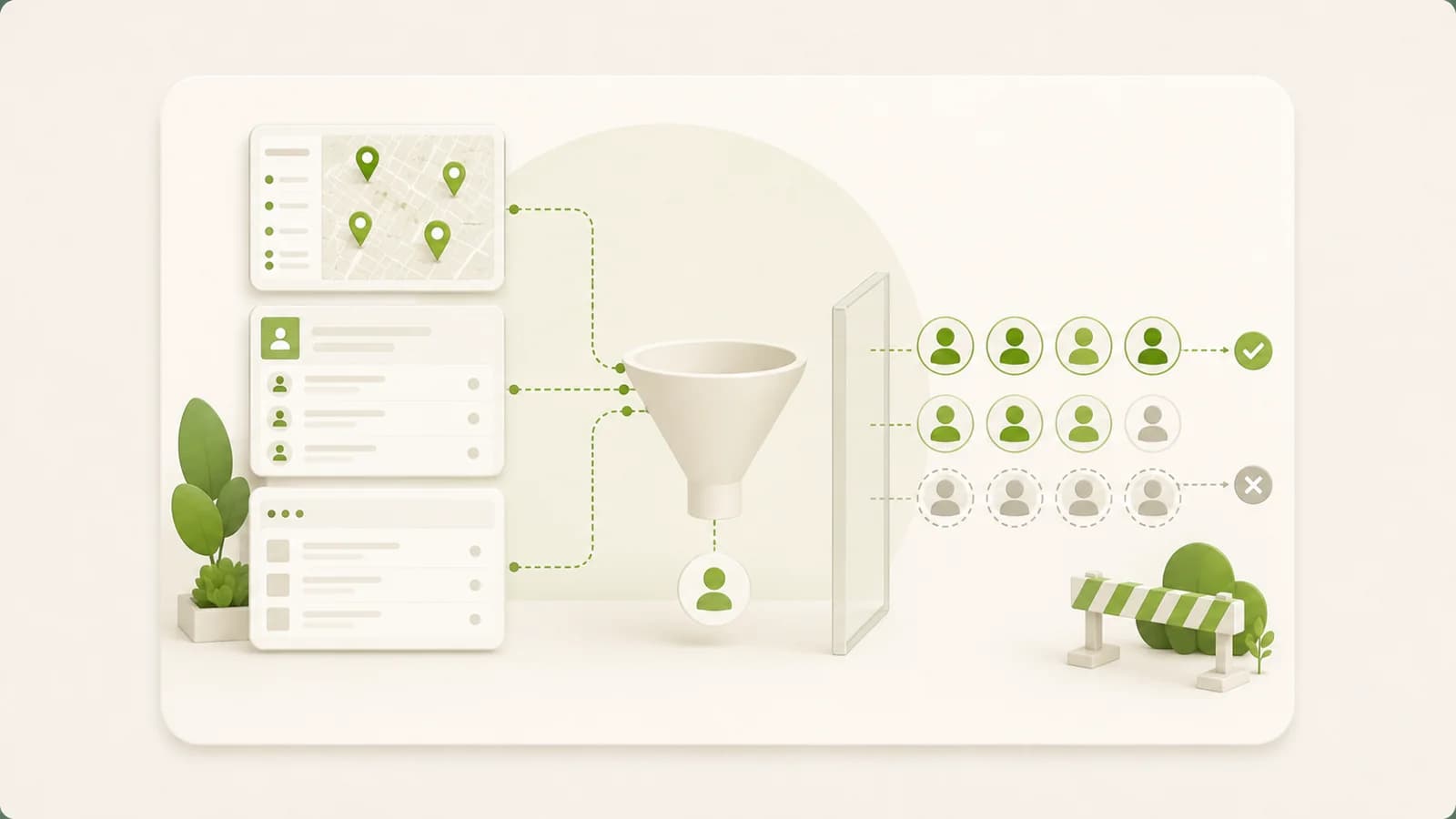
Lead generation for a small business works best as a fixed weekly routine rather than a campaign: one block to build a short list, short daily blocks to contact it, one block to follow up, and a few inbound basics that bring leads in without you. An owner can run the whole thing in roughly four hours a week, and the consistency matters more than any individual tactic.
Think of it as a system rather than a set of tactics. This guide is for the owner who sells to other businesses and does the selling personally — a services firm, a supplier, a small agency, a B2B manufacturer. If you want the step-by-step method for a single campaign, start with how to generate leads; this is the operating rhythm around it.
Why small business lead generation fails
Small businesses rarely fail at lead generation for lack of ideas. They fail because selling happens in the gaps between delivery, so it happens in bursts: a slow month triggers a flurry of outreach, the flurry produces work, the work crowds out selling, and two months later the pipeline is empty again.
The fix is structural. Selling time has to be booked like client time, in small enough blocks that a busy week does not wipe it out. Twenty focused minutes a day survives a busy week; a free Friday afternoon does not.
The four-hour lead generation week
| Day | Block | What you do |
|---|---|---|
| Monday | 60 minutes | Build or top up the list: 20–30 businesses matching your buyer and signal |
| Tuesday | 30 minutes | First touch to a third of the list |
| Wednesday | 30 minutes | First touch to the next third; calls to anyone who replied |
| Thursday | 30 minutes | First touch to the rest; second touch to last week's list |
| Friday | 60 minutes | Third touches, update the log, one referral ask, one piece of inbound work |
A template, not a rule. The fixed part is that each block is on the calendar before the week starts.
The numbers in the table are a starting point. If you have more time, widen the outreach blocks rather than the list block; if you have less, shrink the list rather than skipping the follow-ups, because follow-ups produce replies at the lowest cost.
Twenty to thirty new businesses a week sounds small. Over a quarter it is three hundred or more researched, contacted and followed-up leads — which, for most small businesses selling a considered B2B product or service, is more than enough to fill the calendar.
The Monday list is the step that decides everything else, and the one people skip. Without it, the outreach blocks turn into deciding who to contact instead of contacting them.
Monday: building a list of leads that fit
Keep one sentence at the top of your list describing who you sell to, and add only businesses that fit it and show a reason to buy. For a local buyer, map listings in one or two areas are the fastest source. For B2B companies, their websites, careers pages and LinkedIn pages are.
For each business, note the signal in a column. That column becomes the first line of your message, which is why it has to be specific: 'opened a second branch in Wakad', not 'growing'.
Tuesday to Thursday: short outreach blocks
Each block does one thing: send first touches to a slice of the list, or call. Do not mix research into these blocks — that is what Monday was for.
Write first touches from a short template with one custom line: the signal. That keeps each message to a couple of minutes while still reading as written for that business. Our pieces on cold email that works for local businesses and choosing between a call, WhatsApp and a visit cover the copy and the channel.
Calls are worth their own slot because they convert differently. A business that ignored an email will often pick up the phone, and a two-minute call does more qualifying than a week of emails.
Let Monday's list build itself.
Describe who you sell to; Mantis returns businesses with the signal and the contact already filled in.
Build a listFriday: follow-up, referrals and one inbound task
Follow-ups go first, because they are the cheapest replies you will get all week. Then update the log — even a spreadsheet with a status column will show, after a month, which signals and channels are pulling their weight.
Then make one referral ask. The best time is right after a delivery that went well: "Is there anyone else in your network dealing with the same thing?" Specific asks get specific names; "let me know if you hear of anyone" gets nothing.
Then do one piece of inbound work, so that over months some leads start arriving without outreach.
Inbound lead generation basics for small businesses
Inbound is slow, which is exactly why it belongs in the weekly routine in small doses rather than as a project you start when outbound is going badly.
Complete your Google listing
Category, hours, photos, services and a website link. B2B buyers check it too, especially for suppliers.
Ask every happy client for a review
A steady trickle matters more than a burst. Reviews are what a stranger reads before calling you.
Answer one buyer question a week
A short page or post answering a question you hear on calls. Over a year that is fifty pages buyers search for.
Make the website capture enquiries
A working form that reaches a phone, a WhatsApp link, and a clear next step on every page.
Check the form. A surprising number of small business websites have an enquiry form that posts nowhere or to an address nobody reads, which means inbound leads are being generated and then lost.
Measure the routine, not the result
For the first eight weeks, track whether each block happened, not how many clients it produced. Results lag the habit by a month or more, and judging too early kills the routine before it works.
Adapting the system: local buyers against B2B buyers
The weekly shape stays the same whoever you sell to. What changes is the source on Monday and the channel from Tuesday to Thursday.
If your buyers are local businesses — shops, clinics, restaurants, workshops — build the list from map listings one or two neighbourhoods at a time, and make the phone and the visit your main channels. Owners answer calls and respond to someone standing at the counter; most do not read cold email. Group the list by area so a visit block covers several businesses in one trip.
If your buyers are companies — software firms, manufacturers, agencies, offices — build the list from websites, careers pages and LinkedIn, and lead with email to a named person, followed by a call or a LinkedIn connection. Decision-makers here work from an inbox, and a short, specific email is the least intrusive way in.
If you sell to both, run them as separate lists with separate templates. A message written for a clinic owner reads oddly to a procurement manager, and the reverse is worse.
Whichever applies, keep the definition of who you sell to at the top of the list, and re-read it every Monday. Most lists drift — a few loosely matching businesses get added because they were easy to find, and a month later half the list is people who were never going to buy.
Lead generation tools a small business actually needs
Less than the market suggests. A spreadsheet or simple CRM for the log, your own mailbox, a phone, and a way to build the Monday list faster. Everything else — enrichment add-ons, sequencers, intent data — is optional until the routine is running and you know what to scale.
Mantis covers the list-building and outreach parts in one place: it finds businesses that match a plain-language description, reads each website for buying signals and contacts, and runs an approved email and AI voice-call sequence from your own mailbox. 500 free credits at signup cover a few weeks of Monday lists at 5 credits per new lead. For the broader framework this routine sits inside, see how to find clients.
Four hours a week, with the list done for you.
500 free credits once at signup. Describe your buyer and get leads with signals and contacts attached.
Start freeFrequently asked questions
How can a small business generate leads?
Run a fixed weekly routine: build a short list of businesses that fit your buyer and show a reason to buy, contact a slice each day, follow up on Friday, ask for one referral, and do one small inbound task such as a review request or a useful page.
How much time should a small business owner spend on lead generation?
Around four hours a week is enough for most owner-led B2B businesses if it is spread across short daily blocks. Consistency matters more than the total: twenty minutes every day beats a free afternoon that gets cancelled.
What is the cheapest lead generation for small business?
Referrals and your own outreach to a researched list. Both cost time rather than money. A complete Google listing and steady reviews are the cheapest inbound channel and keep working without you.
Should a small business use paid ads for leads?
Only once you know which offer converts and what a client is worth. Ads amplify a working offer; they do not discover one. Most small businesses learn more per rupee from a hundred direct conversations first.
Which lead generation tools does a small business need?
A log (spreadsheet or simple CRM), your own mailbox, a phone, and something to speed up list-building. Add sequencers or enrichment only after the routine is running and you know what is worth scaling.
Related reading
how to find clients · the seven-step lead process · a weekly prospecting routine · choosing the channel · when cold email works