


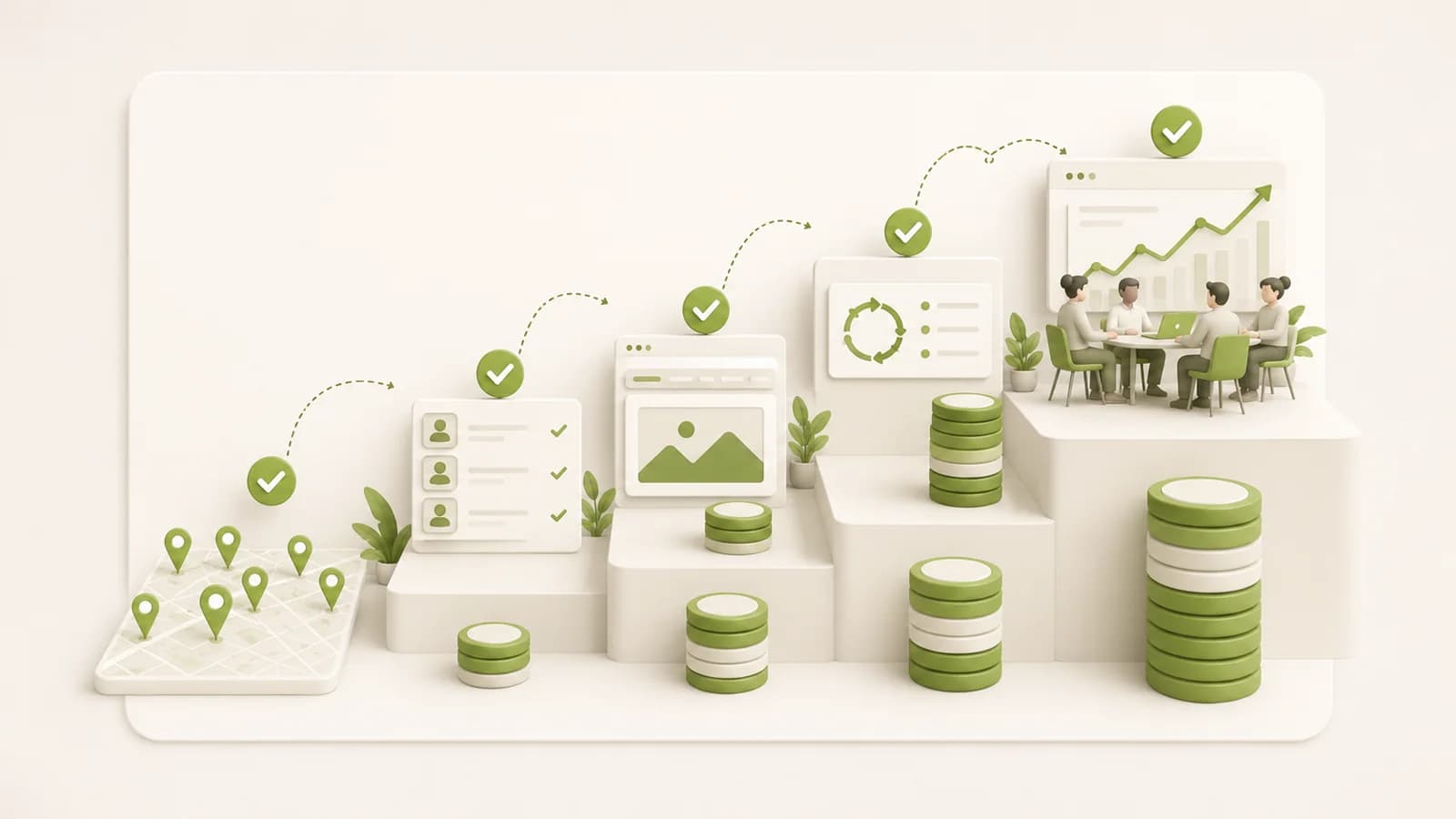
The first 100 users of a B2B startup almost always come from the founders contacting the right people one at a time: a narrow segment, a list built from visible signals that those businesses have the problem, personal outreach, and hands-on onboarding for every user who says yes. Launches, ads and content help later. At this stage they mostly produce sign-ups who never come back.
A hundred users is a useful milestone because it is small enough to reach by hand and large enough to tell you whether people keep using the product. The goal is not a hundred accounts; it is a hundred users who use it, from which you learn who your real customer is.
Narrow the segment until you can name the users
"SMBs" is not a segment. "Physiotherapy clinics in Bengaluru with two or more locations that take bookings by phone" is. A narrow segment lets you find every business in it, write a message that sounds like you understand their day, and get word of mouth going inside a community that talks to itself.
Choose the segment where the problem is sharpest and visible from outside. If your product fixes lost enquiries, look for businesses whose enquiry form does not work. If it is a hiring tool, look for companies hiring for the role it helps with. The signal is what makes outreach feel relevant instead of random.
| If your product… | Look for users who… | Visible signal |
|---|---|---|
| Captures or routes leads | Are losing enquiries | An enquiry form with no working handler |
| Handles bookings | Take bookings manually | No booking link on the site |
| Helps hiring or HR | Are growing headcount | Open roles on the careers page |
| Serves funded startups | Have money to spend now | A funding round in the last year |
| Improves ad performance | Already spend on ads | Running ads, or ad pixels on the site |
| Helps online stores | Sell online without key tools | Store with no reviews or email marketing app |
| Secures websites | Have visible gaps | Expired SSL, outdated CMS, missing security headers |
Build a signal-based list of 300 to 500 businesses
To get 100 active users you need many more conversations, and to get those you need a list several times larger again. A list of a few hundred businesses that show the signal is a reasonable first build; your own reply and activation rates will tell you whether you need more.
Where the list comes from depends on who your users are. Local businesses are on map listings. Software companies, agencies and B2B firms are found through their websites, job boards and funding news. Developer-focused products find users through public developer profiles and communities.
For each business, record the signal you saw and a real contact: the founder's name and a published email, or a role inbox at a small company. That record is your CRM for the first hundred.
Your first 500, filtered by the signal that matters.
Mantis finds businesses on maps and companies on the web — including funded startups — and reads each site for signals like hiring, broken forms and missing booking.
Build the listFounder-led outreach that gets users
Outreach from a founder works better than outreach from a sales hire at this stage, for a simple reason: a founder can change the product in response to the conversation, and the recipient can tell.
Write short, specific messages. Name the signal, describe the problem in their words, and ask for something small — fifteen minutes of feedback, or trying it free while you set it up for them. "I saw your enquiry form on the contact page posts to an address that does not exist — we built a tool that fixes exactly this for clinics. Can I set it up for you this week, free, in exchange for feedback?"
Do things that do not scale. Set the product up for them. Import their data. Join their onboarding call. Every one of these is also research, and it is the fastest way to find out where the product confuses people.
Weeks 1–2: 20 personal messages a day
Founder's own mailbox and LinkedIn. Track replies by signal.
Weeks 2–4: calls with everyone who replies
Learn the problem, not just pitch. Offer hands-on setup.
Weeks 3–6: onboard by hand
Get each new user to the first useful result yourself. Watch where they get stuck.
Weeks 4–8: ask every active user for two introductions
Same segment, same problem. Introductions convert far better than cold messages.
Every week: review activation, not sign-ups
How many used it again after the first week? That number decides what to fix.
Channels for the first 100 users, compared
| Channel | What it tends to bring | Effort | Verdict at this stage |
|---|---|---|---|
| Founder outreach to a signal list | Users with the problem, plus learning | High | Core channel |
| Introductions from active users | Highly qualified users | Low | Best converter once running |
| Communities your users are in | Some users, lots of feedback | Medium | Good if you contribute, not promote |
| Launch platforms | A burst of sign-ups, mostly curious | Medium | Useful bump, rarely retention |
| Content and SEO | Users later | High | Start now, expect results in months |
| Paid ads | Sign-ups at a cost | Budget | Too early: you do not know who converts |
A launch on a platform full of other founders produces sign-ups from people curious about startups, not people with your problem. Do it for the backlinks and the morale, and do not mistake the sign-up graph for traction.
Pricing while you get the first 100 users
Charge earlier than feels comfortable. A free product attracts people who are curious; a paid one, even at a low price, attracts people with the problem — and their behaviour tells you far more about whether the product works.
A common structure is a free period or free setup for early users, with a clear point at which the paid plan starts, and a founding-customer price for those who commit early. Whatever you choose, ask for something in return for any discount: a weekly feedback call, an introduction, permission to use their name.
Watch what people do when the free period ends. Users who convert without being chased are the clearest signal you will get at this stage of who your real customer is, and their profile should become the definition for the next list.
Mistakes that stall the first 100 users
What to measure on the way to 100
Count users who came back, not accounts
A hundred sign-ups and eight returning users is a product problem. Forty users who return every week is the beginning of a business. Report the second number to yourself, every week.
Where Mantis fits for a startup's first users
Mantis is built for the list-and-outreach part of this playbook. Describe your user in plain language and it finds the businesses — on maps, on the web, in funding news or among public developer profiles — and reads each site for the signals in the table above: hiring with role titles, enquiry forms that go nowhere, missing booking, ads running, store apps missing, security gaps.
Leads come with graded emails, phones, the company LinkedIn and the founder's name where the site states it. The Campaign Planner can then run an approved email sequence from your own mailbox, with replies stopping that lead's sequence. New accounts get 500 free credits once, at 5 credits per new lead. For the very first sale before any of this, see how to get your first customer; for the full framework, how to find clients.
Find the hundred businesses with your problem.
Describe the user and the signal. 500 free credits at signup, no card.
Start freeFrequently asked questions
How do I get my first 100 users for a B2B SaaS?
Narrow to one segment where the problem is visible from outside, build a list of a few hundred businesses that show that signal, contact them personally as a founder, onboard every yes by hand, and ask active users for introductions.
Does launching on Product Hunt get you first users?
It produces a burst of sign-ups, mostly from people curious about new products rather than people with your problem. Useful for visibility and backlinks, but rarely the source of retained early users for B2B products.
How many people do I need to contact to get 100 users?
Several times more than 100, and the multiple depends on your segment and signal. Start with a few hundred well-chosen businesses, measure reply and activation rates, then size the next list from your own numbers.
Should I offer my product free to the first users?
A free period or free setup in exchange for feedback is reasonable and lowers the barrier. Ask for something back — feedback calls, introductions, a case study — and move to paid once the product is delivering value.
Should the founder do sales for the first 100 users?
Yes. Founders can change the product in response to conversations, and early users respond to talking to the person who built it. Hire sales once you can write down a repeatable process that works.
Related reading
how to find clients · your first customer · clients from LinkedIn · why tech-stack filters miss prospects · how to generate leads