


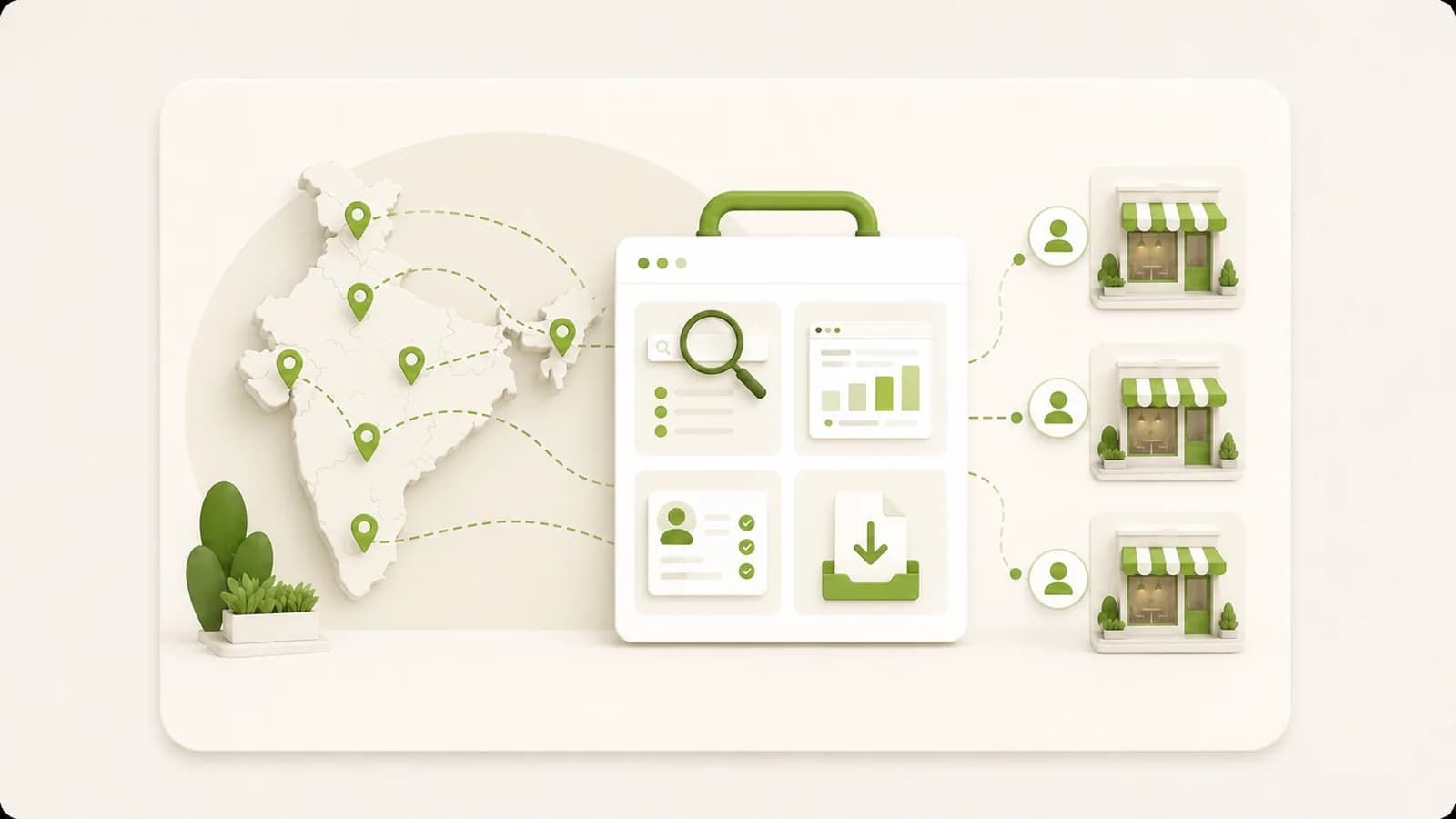
To get customers for a wholesale business, list every retailer and institutional buyer in your delivery area that stocks or uses your category, visit or call them in route-sized clusters, and win the first order on reliability and credit terms rather than only on price — then keep them on a regular visit and reorder cycle. Wholesale customers are local, repeat and relationship-driven, so the work is closer to running a beat than running a campaign.
This guide covers wholesalers and stockists in India selling to shops, restaurants, offices and smaller traders. If you are a brand looking for wholesalers to carry your product, see how to find distributors instead.
Who wholesale customers are
| Customer type | What they care about | How to reach them |
|---|---|---|
| Retail shops (kirana, hardware, pharmacy, stationery) | Credit days, delivery frequency, availability | Walk-in visits on a route, phone, WhatsApp orders |
| Hotels, restaurants and caterers | Consistent quality, early delivery, price stability | Visit the owner or purchase manager, trial supply |
| Offices, schools, hospitals | Invoicing, GST compliance, contracts | Call the admin or purchase head, quote formally |
| Smaller wholesalers in nearby towns | Margin, credit, minimum quantities | Phone, visits on market days |
| Online sellers and resellers | Price, catalogue, dispatch speed | WhatsApp catalogue, marketplace presence |
Most wholesalers have one dominant customer type and a few secondary ones. Know which one pays your bills, and build the prospecting around it.
How to find wholesale customers in your area
Draw your delivery area
Where your vehicles can reach profitably. Customers outside it cost you money however much they buy.
List every outlet in the category
Search map listings by shop type and area: 'hardware store', 'medical store', 'restaurant', street by street.
Mark the likely switchers
New shops, shops that recently expanded, and those near a competitor's weak spot.
Group into routes
Clusters a salesman or you can cover in a morning, visited on fixed days.
Visit, then follow up by phone and WhatsApp
First visit with a rate list and samples; take a small trial order; confirm the next visit date.
Map listings are the single best free source because almost every shop and restaurant has one, with an address and usually a phone. A complete list of a few areas, grouped into routes, is the foundation of a wholesale beat. Our guide to territory planning covers splitting an area between salesmen.
Newly opened shops deserve special attention. A shop that has just opened has not settled its suppliers, and a listing with very few reviews, the first one recent, is often a sign of exactly that.
Institutional buyers need a different approach from shops. Schools, hospitals, hotels and offices rarely buy from a salesman on a route; they buy through an admin or purchase head who asks for a formal quotation, a GST invoice and sometimes a vendor registration form. Find them the same way — map listings by category and area — but call to ask who handles purchasing, then send a proper quotation on letterhead. These accounts order larger quantities on a schedule, which makes them valuable even if there are fewer of them.
Every outlet in your area, in one list.
Describe the shop types and areas. Mantis pulls live listings with phones and flags newly opened ones.
Find wholesale customersWhat wins a wholesale customer
Retailers rarely switch wholesalers for a small price difference, because switching has costs: a new relationship, new credit terms, and the risk that the new supplier is unreliable. What moves them is a problem with their current supplier, or an offer that removes the risk of trying you.
Ask for the second-supplier slot
Do not ask a shop to drop its current wholesaler. Ask to be the backup for the items they run short on. Most long-term accounts start as the second supplier.
A worked example: building a new beat
Take a stationery and office-supplies wholesaler in Jaipur that wants to add two new areas. The customers it wants are stationery shops, photocopy and print shops, schools and small offices.
The list. A search of map listings for each shop type in both areas gives every outlet with an address and, for most, a phone number. Schools and offices go on a separate list because they buy differently — through an admin head, with formal quotes and GST invoices.
The routes. The shops are grouped into clusters that one salesman can cover in a morning, with each cluster assigned a fixed weekday. Newly opened shops and those with high review counts go first in each route: the first are choosing suppliers, the second sell enough to matter.
The first visit. The salesman carries a current rate list, a few samples of fast-moving items, and one offer: be the backup supplier for the items the shop runs short on, with delivery the next morning. Shops that agree get a small first order on cash, and a visit date for the following week.
The follow-up. A WhatsApp message the evening before each visit — 'visiting tomorrow, anything you need?' — turns the route into an ordering habit. Within a couple of months, the shops that ordered repeatedly are offered short credit; the rest stay on cash.
Nothing in that example requires a marketing budget. It requires a complete list, a disciplined route and a reason for the shop to say yes the first time.
Credit: the decision that makes or breaks wholesale growth
Credit wins customers and credit sinks wholesalers. The balance is to give it deliberately: start new customers on short terms and small limits, extend them as payments come in on time, and stop supply quickly when they do not.
Keep a simple ledger per customer with limit, days and current outstanding, reviewed weekly. Growth that comes with an unmanaged outstanding book is not growth.
| Customer stage | Suggested approach |
|---|---|
| New, first orders | Cash or very short credit, small limit |
| Three months of on-time payment | Standard credit days, modest limit |
| Established, growing | Higher limit tied to order volume |
| Late payments | Pause new supply until cleared; do not extend further |
An illustration of the principle, not a policy — set days and limits to your category and margins.
Keeping wholesale customers ordering
Wholesale is a reorder business, so retention is where the money is. A fixed visit day, a reminder message before it, and a quick call to any customer whose orders drop off catch most churn before it happens.
Track order frequency per customer. A shop that ordered weekly and has not ordered in three weeks is either struggling or buying elsewhere — both worth a visit.
Your delivery staff are part of the sales team whether you plan it or not. They see every customer more often than anyone else, and they hear first when a shop is unhappy or a new shop has opened on the street. Ask them, every week, what they saw — and reward them for new-outlet tips that turn into orders.
Selling online widens the net. A WhatsApp catalogue with current rates, and a presence on B2B ordering apps or marketplaces where your customers already buy, lets shops outside your beat find you and order between visits.
Where Mantis fits for wholesalers
Mantis builds the outlet list. Describe the shop types and areas — 'medical stores in Jaipur's Malviya Nagar and Mansarovar', 'restaurants in Gurgaon Sector 29' — and it returns live map listings with phones, ratings and review counts, flags newly opened businesses and several-branch chains, and reads websites where they exist.
It does not replace the beat: the visits, the credit decisions and the relationship are still yours. You can see public examples of what a city holds on our wholesaler listings for Delhi. For the full framework, see how to find clients. New accounts get 500 free credits once.
Build your next beat in minutes.
Shop types and areas in; outlets with phones, ratings and new-business flags out. 500 free credits at signup.
Start freeFrequently asked questions
How do I find customers for my wholesale business?
List every retailer and institutional buyer in your delivery area from map listings, group them into routes, visit with a rate list and samples, and ask for a trial order or the second-supplier slot. Follow up on fixed days by phone and WhatsApp.
How can a wholesaler get more retailers?
Cover your delivery area completely rather than randomly, prioritise newly opened shops and those your competitors serve poorly, offer reliable availability and sensible credit, and make ordering easy with a WhatsApp catalogue and regular visits.
Should a wholesaler give credit to new customers?
Carefully. Start new customers on cash or short terms with small limits, extend as they pay on time, and pause supply when payments slip. Credit wins accounts but unmanaged outstanding balances sink wholesalers.
Can a wholesale business get customers online?
Yes. A WhatsApp catalogue with current rates, a complete Google listing, and presence on B2B ordering apps or marketplaces your customers already use bring orders from outside your regular beat.
What makes retailers switch wholesalers?
Usually a problem with the current supplier — stock-outs, late deliveries, tight credit — rather than a small price difference. Offering to be the backup supplier for fast-moving items is the easiest way in.
Related reading
how to find clients · how to find distributors · territory planning · call, WhatsApp or walk in · wholesalers in Delhi