


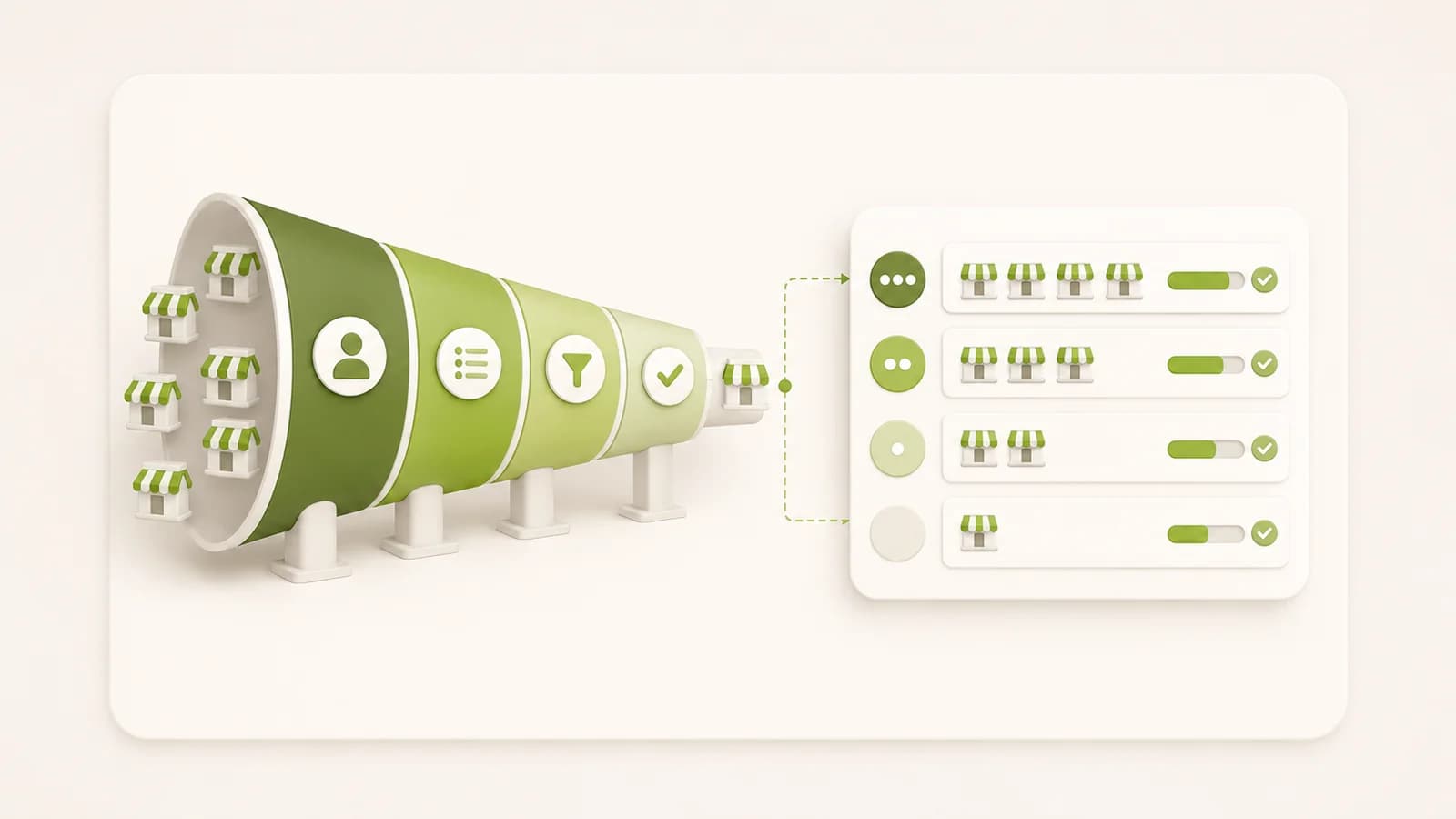
The best CRM leads are businesses whose enquiries have started to outgrow a spreadsheet and a WhatsApp group. The moment a business becomes one of your CRM customers is when it starts losing enquiries it paid to get — a contact form that goes nowhere, ad leads that nobody calls back, a second branch with its own list — and each of those leaves a trace you can find from outside.
That matters because a CRM is not bought for its features. It is bought to stop a specific loss, and the seller who can name that loss in the first message is the one who gets the meeting.
Who becomes a CRM customer
Three conditions together make a business a CRM buyer: enquiries arrive from more than one channel, more than one person handles them, and each one is worth following up. Remove any of the three and a notebook works fine.
That points to a recognisable set of businesses. Real estate brokers and developers, coaching institutes and education consultants, clinics with several doctors, interior designers, travel agents, B2B distributors and manufacturers with field sales, insurance and loan agents, car dealerships, and service firms that quote before they sell.
Size changes what they buy. A five-person business wants something it can set up in a day, priced per user and connected to WhatsApp. A fifty-person business wants pipelines, permissions, reports and integrations, and will run a proper evaluation. Decide which one your product or reseller practice serves, because the leads, the demo and the sales cycle are different.
| Buyer | Where enquiries come from | What they lose today | CRM angle |
|---|---|---|---|
| Real estate brokers and developers | Portals, ads, walk-ins, calls | Portal leads that are never called | Lead assignment and follow-up reminders |
| Coaching and education | Ads, forms, counselling calls | Enquiries in peak admission weeks | Pipeline by course and intake |
| Clinics and diagnostics | Calls, booking requests, WhatsApp | Follow-ups for repeat visits | Patient reminders and recall |
| B2B distributors and manufacturers | Field sales, trade fairs, IndiaMART | Quotes with no follow-up | Quote tracking and sales visits |
| Interior designers and contractors | Referrals, Instagram, site visits | Quotes that go cold | Project pipeline from enquiry to handover |
Illustrative. The third column is what your first message should name.
Signals that show a business needs a CRM
Mantis checks these on a business's own website, its Google listing and its public ad activity. A signal is a reason to look closer, not a verdict — confirm it before you build the pitch on it.
Find businesses whose enquiry forms go nowhere.
Mantis checks each site's contact form for a working handler and flags the ones losing enquiries — filter by category and city.
Search for CRM leadsWhere B2B leads for CRM come from
Contact databases such as Apollo work well when the buyer is a mid-sized company with a domain and named managers. They work poorly for owner-run businesses, which make up much of the CRM market in India, because those businesses lack the domain-and-employee footprint those databases are built on.
Review sites and comparison pages bring buyers who are already evaluating. They are valuable and expensive, and they favour products with many reviews.
Partnerships with accountants, IT vendors and web agencies who already serve the same businesses. A web agency that builds a site with an enquiry form is in the perfect position to recommend where those enquiries should go.
Signal-based prospecting finds businesses at the moment of need — the broken form, the new branch, the ads with nowhere to send leads. Lists are smaller, but conversations start with a real problem rather than a feature tour.
Industry associations and trade fairs in your strongest vertical. A CRM that has real estate configured out of the box sells far better in a room full of brokers than a general one.
What to send a CRM prospect
Name the loss, show the evidence, offer a small next step. Feature lists belong in the demo, not the first message.
Subject: The contact form on your site
“Hi Rahul — I was looking at your site and noticed the enquiry form posts to an email link rather than a system, so on most phones it opens the mail app and many people give up before sending. With your Google ads running, some of those clicks are paying for enquiries that never arrive. We help real estate brokers in Pune route every form, call and portal lead into one list with follow-up reminders. Can I show you what that looks like for a team your size, in 15 minutes?”
Read the form's code to see where it posts — that is enough evidence. Never submit a fake customer enquiry to test it; a prospect who finds out will not buy from you.
For owner-run businesses, a call or WhatsApp message usually works better than email. For companies with a sales manager, LinkedIn plus email reaches the person who will actually use the system.
Packaging a CRM sale
Small businesses rarely fail to buy a CRM because of the price. They fail to use it, and then they cancel. Packaging should be built around getting them using it.
Include setup in the first month: importing their existing list, connecting the website form and WhatsApp, creating the pipeline stages they already use on paper. A CRM that arrives empty stays empty.
Start with the team that feels the loss — the two telecallers, not the whole company. Expand once they depend on it.
If you resell or implement, charge for setup and training separately from the subscription. It covers your real cost and makes the first month a project with a finish line, which is easier for a small business to approve than an open-ended contract.
The demo is their data
Ask for twenty of their real enquiries before the demo and load them in. A prospect watching their own leads move through stages can decide in the meeting; a prospect watching sample data asks for a trial and forgets it.
Qualifying a CRM prospect
CRM deals stall more often than they are lost. A few questions early on tell you whether a prospect will buy this quarter or drift.
How many enquiries a month, and from where? A business with twenty enquiries a month from one channel can manage in a spreadsheet. One with two hundred across portals, ads, calls and walk-ins cannot. The number also tells you which plan to propose.
Who will use it every day? The owner signs, but the telecaller or front-desk person decides whether the system lives or dies. If they are not in the demo, the trial usually fails.
What do they use now, and what happens to it? Many businesses already pay for a tool they barely use. Find out why it failed. If it was too complicated, a simpler product wins; if nobody was trained, the same thing will happen to yours unless setup is included.
What would make this worth it in three months? Get a concrete answer — fewer missed callbacks, a weekly report for the owner, faster follow-up on portal leads. That answer is your success measure and your renewal argument.
A prospect who cannot answer the first question is early. Keep them on a follow-up list rather than pushing a demo, and check their signals again in a quarter.
A repeatable way to find CRM customers
Pick one vertical
Real estate, education, clinics or distribution. A configured pipeline sells better than a blank one.
Search for the loss
Broken enquiry forms, ads with heavy inbound, new branches, sales hiring.
Confirm the evidence
Read the form's code, check the ad library, open the careers page.
Name the loss in the first line
One specific observation, one offer of a short demo.
Demo with their own enquiries
Load real leads before the meeting.
Track which signal closes
Keep the signal-vertical pairs that convert and drop the rest.
Find the businesses losing enquiries.
Describe your CRM and its best-fit vertical — Mantis finds the businesses with broken forms, heavy ad spend and new branches, with phone numbers.
Find CRM customersFrequently asked questions
Where can I find CRM leads?
From businesses showing signs that enquiries are being lost: a contact form with no working handler, active ads, several branches, or open sales and telecalling roles. Contact databases help for mid-sized companies, but miss most owner-run businesses.
Who are typical CRM customers?
Businesses where enquiries come from several channels, more than one person handles them, and each one is worth following up: real estate, education, clinics, B2B distributors, interior designers, travel agents and dealerships.
How do I sell a CRM to small businesses?
Name the specific loss in your first message, demo with their own enquiries, and include setup in the first month. Small businesses rarely refuse on price; they cancel when the CRM stays empty.
Are Apollo or similar databases good for B2B CRM leads?
For companies with a domain and named managers, yes. For owner-run local businesses, which are a large part of the CRM market in India, they have little coverage, and map listings plus website signals work better.
How do I know a business is losing enquiries?
Check whether its website form posts to a working system or only opens an email link, whether it is running ads, and whether it has several branches without a shared process. Mantis flags the form problem automatically.
Related reading
the full guide to finding clients · managed IT and cloud clients · accounting and CA clients · why contact databases miss local businesses · sizing your pipeline · the lead market