




Contents 11 sections
- The four cold email reply rate benchmarks everyone quotes
- Why the same metric lands 7× apart
- The methodology of each study, side by side
- Instantly's 3.43%: the generous end
- Smartlead 0.74% and Woodpecker 1.5%: the medians
- Belkins' 0.45%: the strictest count, and who replies most
- Which benchmark should you compare yourself with?
- How to calculate your own cold email reply rate
- What's realistic for cold email to Indian small businesses
- Five levers that move your reply rate, with the data
- Frequently asked questions
The cold email reply rate benchmark you see depends on who measured it. Four widely quoted 2026 studies put the typical rate at 3.43%, 1.5%, 0.74% and 0.45%, a spread of more than 7×.
None of them is wrong; each divides different things.
The four cold email reply rate benchmarks everyone quotes
Each figure was checked on its source page on 22 November 2026. Instantly's 2026 benchmark report is the most quoted, partly because it is the highest.
Belkins' 2025 study is the lowest, partly because it is the strictest.
Between them sit two medians: Smartlead at 0.74% of contacts and Woodpecker at 1.5% per campaign.
A sender with a 1% reply rate is below average by one study and above median by another.
Instantly, Woodpecker, Smartlead and Belkins benchmark pages, checked 22 Nov 2026
Why the same metric lands 7× apart
Reply rate sounds like one number, but it is a fraction, and every study picks its own top and bottom.
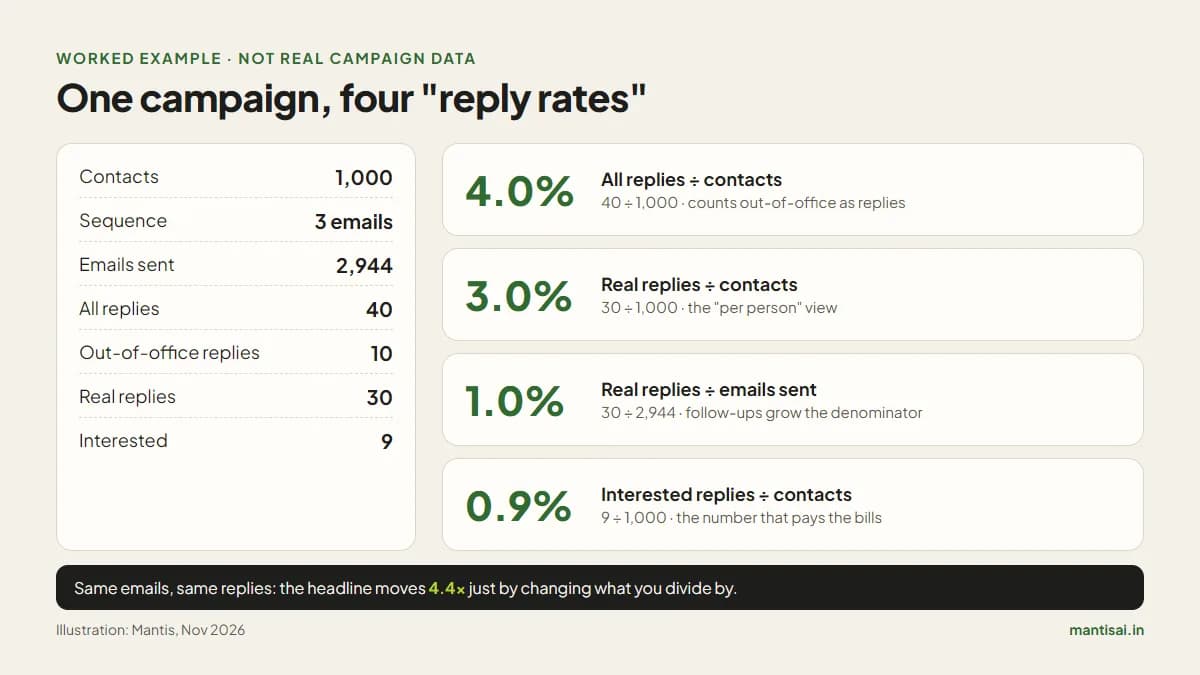
Studies differ on replies per email or per person, auto-replies in or out, average or median, and whose campaigns they measured. One invented campaign moves 4.4× across four definitions.
The methodology of each study, side by side
This is the table we could not find anywhere else. Every cell comes from the study's own page; where a page is silent, we say so rather than guess.
| Study | Headline | Data | Period | Divides by | Auto-replies | Statistic |
|---|---|---|---|---|---|---|
| Instantly 2026 | 3.43% | "Billions" of interactions, thousands of workspaces | 1 Jan – 18 Dec 2025 | Emails sent (all replies, incl. follow-ups) | Not stated | "Average", method not stated |
| Woodpecker | 1.5% | 56,614 campaigns, about 7,000 companies, agencies excluded | Last 90 days of 2025 | Not defined on page | Not stated | Median per campaign |
| Smartlead H1 2026 | 0.74% | 850M+ emails; senders with 500+ sends | Jan – Jun 2026 | Contacts | Not stated | Median sender |
| Belkins 2025 | 0.45% | 7,530,489 emails, 34,393 replies | Jan – Dec 2025 | Emails sent (unique replies) | Excluded, with bounces | Average of all sends |
| Verdict: Belkins is the strictest and most transparent; Smartlead's per-contact median is the fairest yardstick for a typical sender; Instantly's 3.43% is a target for strong campaigns, not a norm. | ||||||
Sources: instantly.ai/cold-email-benchmark-report-2026 (updated 12 Jan 2026), woodpecker.co/cold-email-benchmark (updated 5 Aug 2026), smartlead.ai/benchmarks (H1 2026 report), belkins.io/blog/cold-email-response-rates (updated 26 Jun 2026). Checked 22 Nov 2026.
Instantly's 3.43%: the generous end
Our take: treat 3.43% as "good", not "normal"
Instantly's page does not say whether 3.43% is total replies over total sends or an average of campaign rates, nor whether auto-replies count. Both choices push a number up.
Instantly defines reply rate as all replies, including responses to follow-ups, divided by total emails sent.
Its tiers say the top quarter of campaigns reach 5.5% or more and the top tenth 10.7% or more.
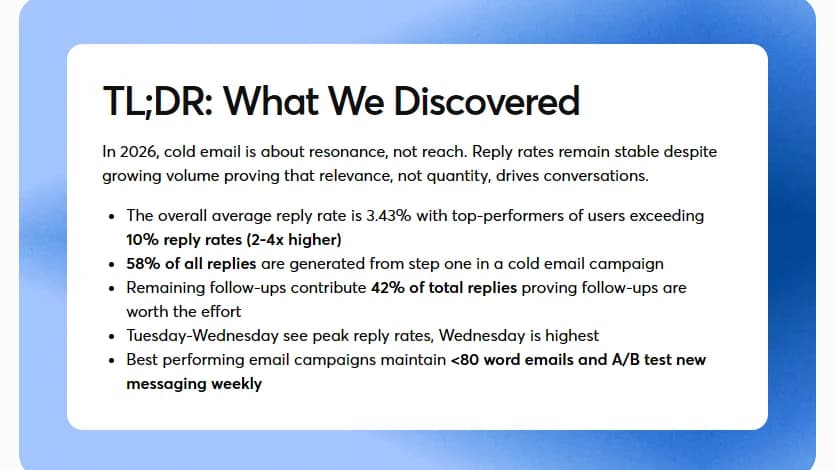
Its most useful findings are about shape, not level. First emails produce 58% of replies and follow-ups the other 42%.
Instantly recommends four to seven touches, and says its best performers keep first emails under 80 words.
Smartlead 0.74% and Woodpecker 1.5%: the medians
Smartlead's reply rate benchmark is the cleanest for a typical sender: the median sender gets a reply from 0.74% of contacts, about one per 135.
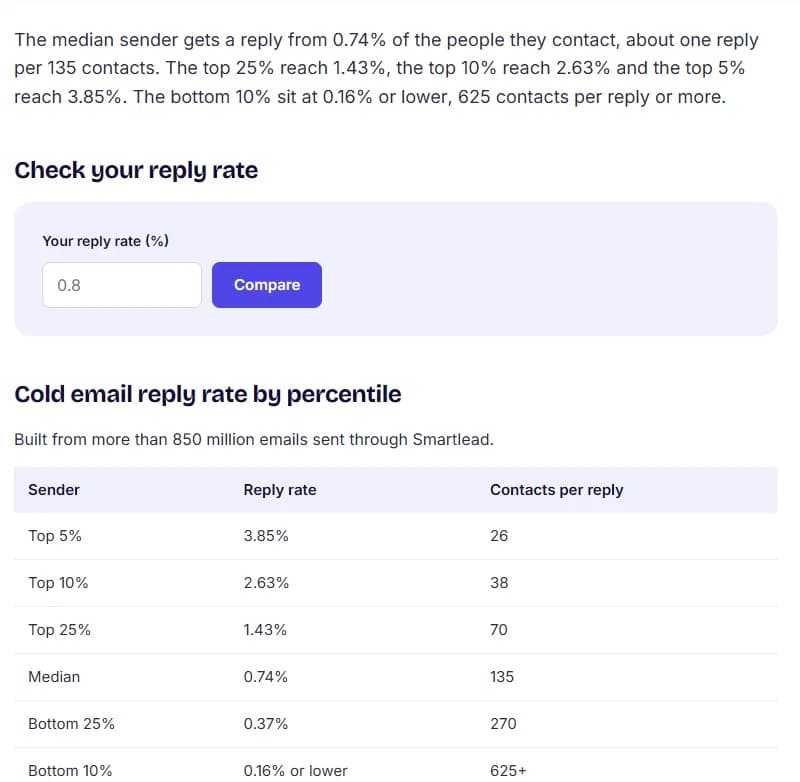
Smartlead also shows how fast later emails fade. The first email earns a reply every 85 contacts, about 1.18%. The seventh needs 303 contacts per reply, about 0.33%.
Woodpecker's benchmark page reports a 1.5% median across 56,614 campaigns, without defining the denominator.
Its bounce data is the useful part: campaigns with 0–2% bounces had a 1.6% median reply rate; those above 20% fell to 1.0%.
Belkins' 0.45%: the strictest count, and who replies most
Belkins counts unique replies over emails sent and removes auto-replies and bounce notices. The 7.5 million emails were its own agency's campaigns to net-new contacts.
Older Belkins reports divided by people who opened, so they are not comparable.
Its segment data is the most useful in any of the four studies for small-business sellers.
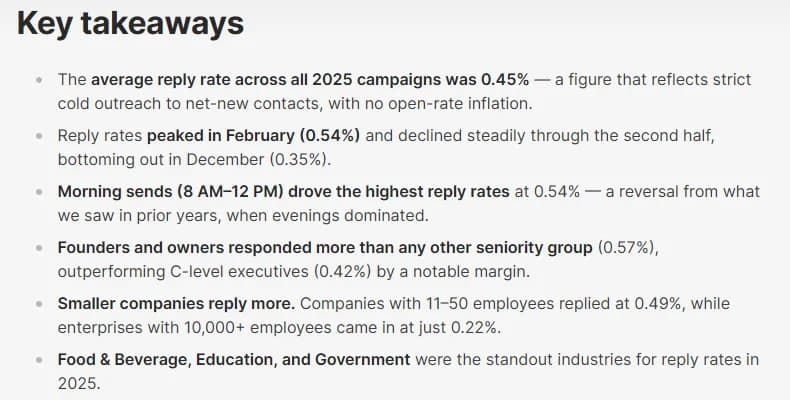
Belkins, cold email response rates study, Jan–Dec 2025 data
Founders and owners replied at 0.57%, ahead of C-level executives at 0.42% and VPs at 0.32%.
Companies with up to 10 employees replied at 0.72%, more than three times the 0.22% of firms with 10,000+ staff. Morning sends did best at 0.54%.
Owners of small businesses reply most. Find the ones that fit you.
Describe your ideal customer; Mantis finds matching owner-run businesses, unlocks their contacts and can run the outreach for you. Earn up to 500 free credits as you set up.
Find owner-run leadsWhich benchmark should you compare yourself with?
Pick the study whose formula matches how your tool counts, then compare like with like. Most sending tools report replies per contact or per lead, so Smartlead's percentiles are usually the right ruler.
Track interested replies separately
Whatever benchmark you pick, a 3% reply rate of "remove me" is worse than 1% of "send details". Report interested replies ÷ people emailed as a second number.
How to calculate your own cold email reply rate
Vendors count replies on different bases, so your own number is the only one you can compare over time. Pick one formula and keep it fixed across campaigns.
The formula
Reply rate = unique people who sent a real reply ÷ unique people you emailed × 100. Remove out-of-office and bounce replies first. Then report interested replies ÷ people emailed as a second number.
Count people, not emails
Use contacts who received at least one email as the bottom of the fraction, so follow-ups do not dilute it.
Strip the noise
Remove auto-replies, bounce notices and duplicates before you count replies.
Split by intent
Tag each reply interested, not now, wrong person or remove me. Interested is the number that matters.
Wait for the sequence to finish
Measure after the last step plus a week; early numbers miss the 42% of replies that follow-ups bring.
With 200 contacts, a single reply moves the rate by half a point. Judge small campaigns on the replies themselves, and compare rates only at a few hundred people.
Our guide on how many businesses should be in your pipeline covers sizing.
What's realistic for cold email to Indian small businesses
No published study gives an India benchmark. Belkins lists the US (0.51%) and UK (0.48%) but not India, and the platform studies do not break out countries.
Two findings do carry over. Owners and the smallest companies reply most, and Indian MSMEs are exactly that buyer.
Shorter emails do better too: Smartlead finds emails under 50 words earn a reply every 68 contacts, against 97 for 100–149 words.
The bigger constraint in India is reach. Many local businesses publish no email at all.
Of the 4,41,392 businesses Mantis has mapped and checked, 1,87,941 have no website of their own to publish one on (Mantis index, Nov 2026).
See the digital marketing leads list for Bangalore for what a signal-led list looks like.
For those businesses without websites, a call or WhatsApp is the only route.
That is why email works best as one channel among several, and why WhatsApp needs its own rules; see WhatsApp cold messaging in India.
Our take on when cold email works for local businesses and how many touches a local business needs go deeper.
Owners reply most: businesses with no Meta pixel and no Google Ads tag, 92,950 in the Mantis index, Nov 2026 (rows shown from Bangalore)
| Business | Category | City | Signal |
|---|---|---|---|
| Truffles Koramangala | Restaurant | Bangalore | No Meta pixel, no Google Ads tag |
| The Fisherman's Wharf | Indian restaurant | Bangalore | No Meta pixel, no Google Ads tag |
| Dyu Art Cafe | Cafe | Bangalore | No Meta pixel, no Google Ads tag |
| The Hole In The Wall Cafe | Cafe | Bangalore | No Meta pixel, no Google Ads tag |
| Karnataka Chitrakala Parishath | Art gallery | Bangalore | No Meta pixel, no Google Ads tag |
Five levers that move your reply rate, with the data
The studies disagree on the level but agree on the levers. Each of these is backed by at least one of the four sources above.
- Before sendingShrink and sharpen the list
Woodpecker's low-bounce campaigns beat high-bounce ones 1.6% to 1.0%. Verify addresses and cut weak fits.
- Email 1Write under 80 words
Instantly's best performers stay under 80; Smartlead sees under 50 words beat 100–149 words.
- Days 3–14Follow up 3 to 6 times
Follow-ups bring 42% of replies in Instantly's data, though each later step earns less (Smartlead: 1.18% at step 1, 0.33% at step 7).
- TargetingEmail owners, not departments
Belkins: founders and owners 0.57%, VPs 0.32%.
- TimingSend in the morning, mid-week
Belkins: 8 AM–12 PM sends 0.54%; Wednesday and Thursday 0.48%.
A sixth lever the studies cannot measure is the reason you are writing.
A note that points at something true about the business, such as a missing booking page, gives the owner a reason to answer.
Mantis finds businesses that match your ideal customer profile and reads each website for gaps like that; see SEO leads in Gurgaon for sites with no analytics.
Write to businesses with a reason to reply
Mantis finds local businesses, reads their websites for gaps, and finds the emails and phone numbers they publish. Earn up to 500 free credits as you set up.
See leads with signalsFrequently asked questions
What is a good reply rate for cold emails?
Against Smartlead's 2026 data, which divides replies by contacts, anything above 0.74% beats the median sender, 1.43% is top quarter and 2.63% is top tenth. Instantly, which divides by emails sent, calls 5.5% top quartile. Check which formula your tool uses before comparing.
What is the average cold email response rate in 2026?
It depends on the study: Instantly reports a 3.43% average, Woodpecker a 1.5% median, Smartlead a 0.74% median and Belkins a 0.45% average. The spread comes from different formulas, samples and periods, not from one of them being wrong.
Is a 1% cold email reply rate good?
By Smartlead's per-contact benchmark, 1% is above the 0.74% median but below the 1.43% top-quarter line. By Belkins' stricter per-email count, 1% would be more than double its 0.45% average. Look at how many replies were interested before judging.
What is a good cold email open rate?
Open rates are unreliable because of tracking limits, which is why Woodpecker tells senders to focus on reply rate instead. Woodpecker reports a 26% median open rate, but use replies, not opens, to judge a campaign.
Do follow-up emails increase reply rate?
Yes. In Instantly's 2025 data, follow-ups produced 42% of all replies. Each later step earns less, though: Smartlead finds the first email gets a reply every 85 contacts and the seventh every 303, so three to six well-spaced follow-ups is the usual range.
Is there a cold email reply rate benchmark for India?
Not in the major published studies; Belkins lists the US at 0.51% and the UK at 0.48% but not India. Measure your own campaigns, and expect owners of small businesses to reply more often than managers at large firms, as Belkins found.

Builds Mantis and runs Gigzman, a web design and software studio in Gurugram. Sells websites to local businesses for a living, which is where these playbooks come from.
Related reading
 OutreachWhatsApp Cold Messaging in India: Rules & Cost per Message9 min read →
 OutreachTRAI Rules for Cold Calling (2026): 140 vs 1600 and AI Calls10 min read →
 OutreachSPF, DKIM and DMARC Explained for Non-Techies (Setup Steps)9 min read →
Start here: Prospecting & sales · When cold email works for local businesses · How many touches before a local business buys · WhatsApp cold messaging in India: rules and cost · How many businesses should be in your pipeline