


Contents 10 sections
- Can you send cold WhatsApp messages in India?
- WhatsApp Business app vs Business Platform: which rules apply
- What counts as opt-in on WhatsApp
- What a WhatsApp marketing message costs in India
- WhatsApp pricing changes from 2025 to 2027
- The real cost of 1,000 WhatsApp messages, worked out
- Per-user limits, quality and templates: why blasting fails
- Three WhatsApp follow-up templates for people who said yes
- Where WhatsApp fits in an Indian outreach sequence
- Frequently asked questions
WhatsApp cold messaging in India is allowed only in a narrow sense.
Meta lets a business message someone only after that person opts in, so a truly cold first message to a stranger breaks WhatsApp's policy.
Not legal advice
This is a plain-language summary of Meta's published rules and prices, checked on 22 Nov 2026. It is not legal advice. India's DPDP Act adds its own consent duties, most of which start on 13 May 2027. Ask a lawyer before you build a programme on it.
Can you send cold WhatsApp messages in India?
Not to strangers. Meta's opt-in guide says businesses must get opt-in before messaging people, and it must name your business. The rule was tightened in Meta's November 2024 policy update.
The opt-in does not have to mention WhatsApp. Meta says it can be general, as long as you follow local law. A clear yes on your website form or a signed enquiry slip both count.
You can message people who said yes, reply to people who wrote first, and run Click-to-WhatsApp ads.
Not permission
A number scraped from a directory, a phone printed on a Google listing, or a WhatsApp button on someone's website. Those invite people to contact the business; they are not permission for you to contact them.
The free WhatsApp Business app has its own brake. WhatsApp's broadcast help page says a broadcast only reaches people who saved your number.
Strangers never see it, and reports from people who did not expect you can get a number banned.
The first touch is a call, an email or an ad, and WhatsApp starts once the person agrees. Our guide to choosing between a call, WhatsApp or a walk-in covers that order for local businesses.
WhatsApp Business app vs Business Platform: which rules apply
Indian businesses use two different products, priced in completely different ways. The app is free and manual.
The Business Platform, often called the WhatsApp API, bills each delivered message and is what bulk sending tools run on.
| Question | WhatsApp Business app | WhatsApp Business Platform (API) |
|---|---|---|
| Cost to send | Free | Per delivered message, by category and country |
| Who you can message | Anyone, one by one; broadcasts reach only people who saved your number | Only people who opted in, with approved templates to start a chat |
| Bulk sending | Broadcast lists, manual | Yes, through a provider (BSP) or Meta's Cloud API |
| Templates | Quick replies, no approval | Meta approves each template and its category |
| Best fit | A founder replying to warm leads by hand | Teams sending hundreds of follow-ups a month |
| Verdict: The app is free but caps your reach; the Platform scales but bills every message and still needs opt-in. | ||
What counts as opt-in on WhatsApp
Meta accepts SMS, website forms, an IVR phone flow, and in-person or paper sign-ups. Whatever you use, keep a record.
Meta also suggests separate opt-ins by message type, so people can stop promotions and still get order updates.
Let them send the first message
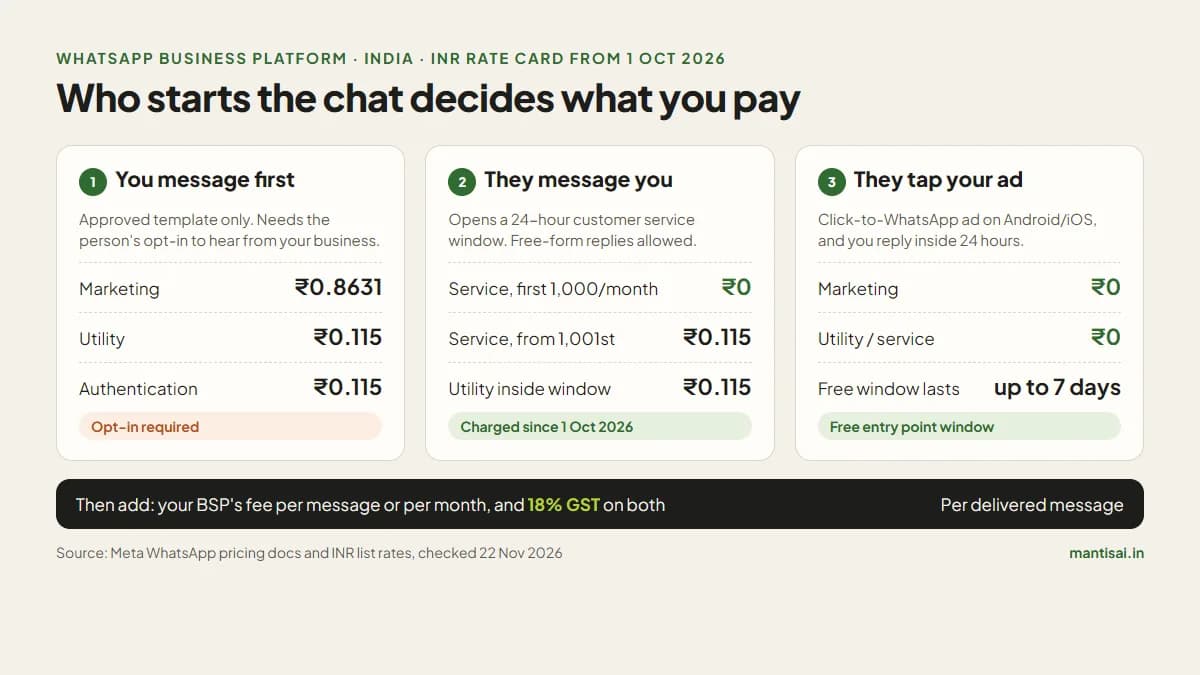
After a call or an email, send a wa.me click-to-chat link and ask them to say hi. Their message opens a 24-hour customer service window, so your reply is a service message, not a marketing template. Meta gives each number 1,000 of those free every month.
What a WhatsApp marketing message costs in India
Since 1 July 2025, Meta has charged per delivered message instead of per 24-hour conversation. Messages people send you are free, and undelivered messages are not charged.
The price depends on the message category and the recipient's country code.
Meta's INR list rates, effective 1 October 2026, give India: marketing ₹0.8631, utility ₹0.115, authentication ₹0.115 and service ₹0.115.
Businesses based abroad that send OTPs to Indian numbers can pay the authentication-international rate of ₹2.4971 instead.
In US dollars the India marketing rate is $0.0118, the second-lowest of the 47 markets on Meta's card after Turkey.
Cheap messages make blasting tempting, which is why Meta polices volume with opt-in rules and per-user limits instead.
WhatsApp pricing changes from 2025 to 2027
The model changed four times in 18 months, and older posts still quote per-conversation prices. These dates come from the update log on Meta's pricing page.
- 1 Jul 2025Per-message pricing starts
Charges move from 24-hour conversations to each delivered template. Utility templates inside a customer service window become free.
- 1 Jan 2026India marketing rate goes up
Meta's log lists India marketing as "Higher". The same day, INR billing launches for Indian businesses and partners.
- 1 Apr 2026India authentication-international rises
Affects OTPs sent to Indian numbers by businesses billed abroad.
- 1 Oct 2026Free messages get charged again
Service replies are billed after the first 1,000 per number per month, and utility messages inside the 24-hour window are charged.
- 31 Dec 2026INR migration deadline
Eligible Indian accounts still billed in another currency stop delivering messages from 1 Jan 2027.
Meta now changes prices only on the first day of a quarter, with at least a month's notice for rate changes. Recheck the rate card each January, April, July and October.
The real cost of 1,000 WhatsApp messages, worked out
Meta's rate is only the floor. Most Indian businesses send through a Business Solution Provider (BSP), which adds a markup or a monthly fee.
MyOperator's India pricing guide puts markups at ₹0.10–₹0.30 per message, with 18% GST on both Meta's charge and the BSP fee.
Here is what 1,000 delivered messages cost under those assumptions, using a ₹0.20 markup as the middle case.
| 1,000 delivered messages | Meta charge | + BSP at ₹0.20 | + 18% GST | Total |
|---|---|---|---|---|
| Marketing template | ₹863.10 | ₹200.00 | ₹191.36 | ₹1,254.46 |
| Marketing, Meta only (direct Cloud API) | ₹863.10 | ₹0 | ₹155.36 | ₹1,018.46 |
| Utility template | ₹115.00 | ₹200.00 | ₹56.70 | ₹371.70 |
| Service replies, first 1,000 this month | ₹0 | ₹200.00 | ₹36.00 | ₹236.00 |
| Any category inside a Click-to-WhatsApp free window | ₹0 | ₹200.00 | ₹36.00 | ₹236.00 |
| Verdict: A marketing message lands near ₹1.25 all-in; get the person to message you first and the same reach costs about a fifth of that. | ||||
Meta rates: INR list rates for India, effective 1 Oct 2026. BSP markup: illustrative mid-point of the range MyOperator reports; flat plans of ₹999–₹9,999 a month also exist. Some BSPs publish all-in prices: AiSensy's 31 Dec 2025 post lists ₹1.09 per marketing message.
The gap grows with volume. Ten thousand marketing templates a month come to roughly ₹12,500 all-in. The same 10,000 follow-ups sent as service replies cost about ₹1,035 in Meta charges after the free 1,000.
Sequence design saves more than haggling with a BSP.
Start with a call, not a cold WhatsApp
Describe your ideal customer. Mantis finds matching local businesses with their public phone numbers, and its AI voice agent can make the first call that earns the WhatsApp yes. Earn up to 500 free credits as you set up.
Find businesses to callPer-user limits, quality and templates: why blasting fails
Even with opt-in, Meta caps how many marketing templates one person receives from all businesses. Its per-user limits documentation says the cap adapts to that person's recent read rate.
A blocked send fails with error 131049.
Retrying within 24 hours makes it worse, and can block further attempts to that user for up to a day.
Marketing templates sent inside an open 24-hour window, after the person replied, do not count toward the cap.
Three WhatsApp follow-up templates for people who said yes
Each template assumes a real opt-in and uses Meta's {{1}}-style variables. Keep them short, reason first, with a way out. For first-touch scripts from a personal phone, see our WhatsApp outreach scripts for local businesses.
1. After a call: "Send me the details on WhatsApp"
Hi {{1}}, this is {{2}} from {{3}}. As promised on our call today, here are the details you asked for:

{{4}}

Reply here with any questions. If you'd rather not get messages from us, reply STOP and we won't write again.
Category: utility only if it is purely the information they asked for, with no offer; add a discount or pitch and Meta treats it as marketing (₹0.8631). Opt-in: their yes on the call. Log the date and time, and confirm it in writing.
Better still, text a wa.me link right after the call and let them send the first message, so your details go out as a service reply.
Our note on what to send a local business after the call covers what to include.
2. After an email reply that moves the chat to WhatsApp
Hi {{1}}, {{2}} here from {{3}}. You replied to my email and asked to continue on WhatsApp, so here is the short version:

{{4}}

Would {{5}} work for a 15-minute call? Reply STOP to opt out.
Category: marketing, since it proposes a meeting. Opt-in: their written email reply that shares the number and asks for WhatsApp. Save that email with the lead record.
Keep the email and the WhatsApp message saying the same thing. Someone who replied to a 70-word email will not read a 300-word WhatsApp essay.
3. Click-to-WhatsApp ad enquiry, day-three follow-up
Hi {{1}}, thanks for messaging {{2}} about {{3}}. Sharing the price list you asked for:

{{4}}

Shall I hold a slot for you this week? Reply YES and I'll confirm the time.
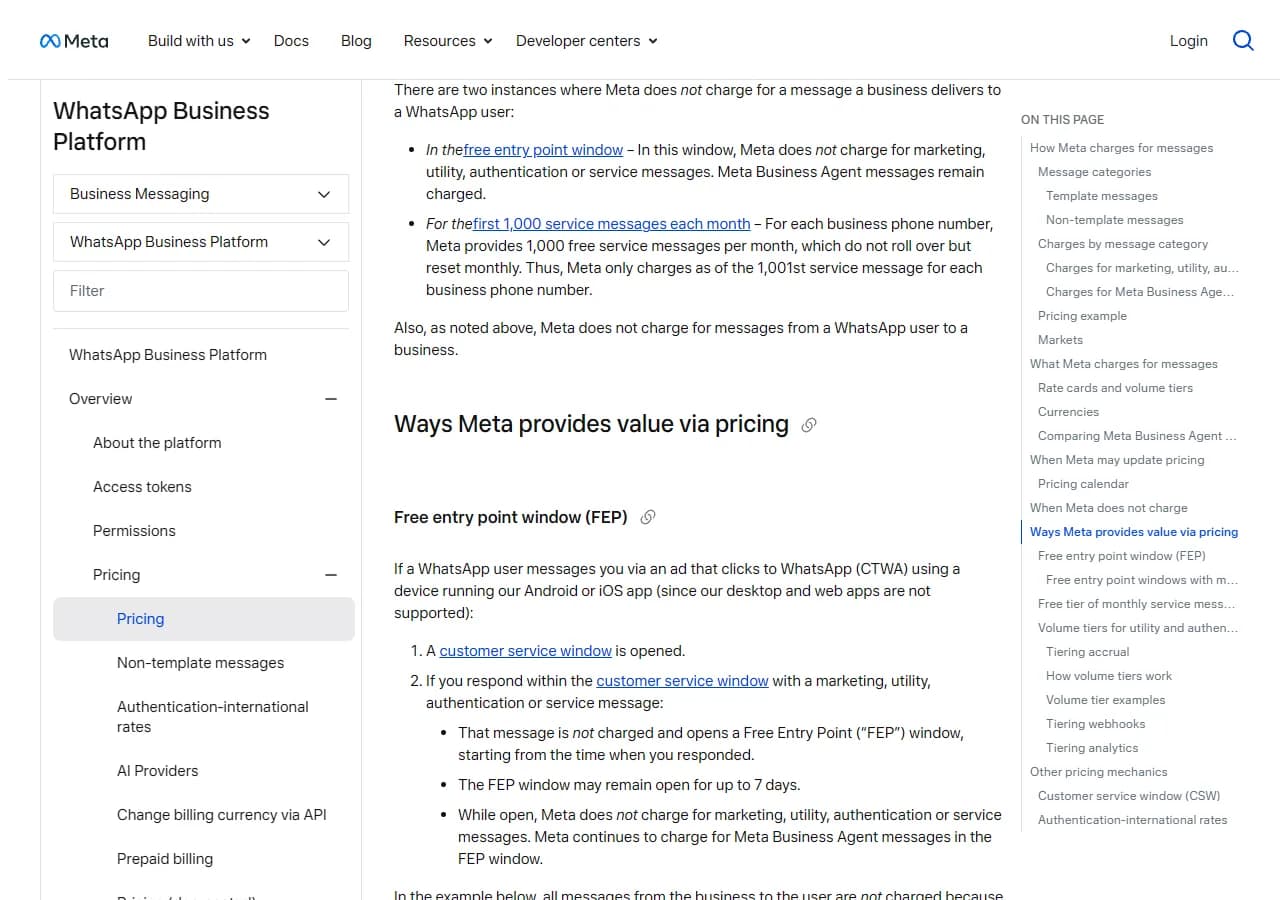
Category: marketing. Cost: free if you replied to their ad message within 24 hours and this goes out inside the free entry point window, which Meta says can stay open up to 7 days. Opt-in: they messaged you first from your ad.
Where WhatsApp fits in an Indian outreach sequence
For small Indian businesses, the order that respects the rules also tends to work: find the business, call or email first, ask permission, then move to WhatsApp.
The call is where you earn the yes, and our cold calling tips cover the first 30 seconds.
Mantis covers the first two steps: describe your ideal customer and it finds matching businesses from live Google Maps data and shows the public phone number when you unlock a lead.
Its AI voice agent can make the first call in Hindi or English; bulk WhatsApp campaigns are marked coming soon.
Our take
WhatsApp is the follow-up channel, not the door-opener. Earn the yes on a call or an email, then let the person message you first: it keeps you inside Meta's rules and turns paid templates into free service replies.
Selling WhatsApp automation? Businesses that already sell on WhatsApp: 18,003 with a WhatsApp link on their website (rows shown from Mumbai)
| Business | Category | City | Signal |
|---|---|---|---|
| Naaz Hotel Family Restaurant | North Indian restaurant | Mumbai | WhatsApp on website |
| Mockingbird Cafe Bar | Cafe | Mumbai | WhatsApp on website |
| Cafe Irani Chaii | Cafe | Mumbai | WhatsApp on website |
| Arihant Cars | Car dealer | Mumbai | WhatsApp on website |
| The Ageless Clinic | Skin care clinic | Mumbai | WhatsApp on website |
Those five are from Mumbai. Across the business websites Mantis has read, 18,003 carry a WhatsApp link (Mantis index, Nov 2026); see WhatsApp marketing leads in Mumbai.
For businesses with no website, start from businesses without websites, where the Maps phone number is the only channel.
Measure each channel on its own terms. If email is in the mix, our cold email reply rate benchmarks explain why vendors' numbers differ.
If you build lists, our DPDP guide for cold email explains why each record's source matters.
Frequently asked questions
Is WhatsApp marketing legal in India?
Yes, to people who opted in to hear from your business. Meta's policy requires opt-in that names your business before you message anyone, and India's DPDP Act adds consent duties, most of which apply from 13 May 2027. Messaging strangers breaks Meta's rules and risks a ban.
What is the WhatsApp marketing message cost in India?
Meta's INR rate card, effective 1 Oct 2026, charges ₹0.8631 per delivered marketing message to an Indian number. Provider fees and 18% GST come on top, so at typical markups a marketing message costs about ₹1.02 to ₹1.37 all-in.
Is WhatsApp marketing free?
Only partly. The WhatsApp Business app is free but broadcasts reach only people who saved your number. On the Business Platform, messages people send you are free, the first 1,000 service replies per number each month are free, and replies inside a Click-to-WhatsApp ad window are free.
Can I send a WhatsApp message to an unsaved number?
You can message one person at a time from the app, but broadcasts only reach people who saved your number. On the Business Platform you can reach any opted-in number with an approved template. Messaging people who never agreed leads to blocks, reports and quality limits.
How can I send a WhatsApp message to 10,000 contacts?
Use the WhatsApp Business Platform through a provider or Meta's Cloud API, with approved templates, and only to contacts who opted in. At Meta's India marketing rate, 10,000 delivered marketing messages cost ₹8,631 before provider fees and GST, and per-user limits may block some.
What is the WhatsApp Business API cost per month?
Meta charges no fixed monthly fee; you pay per delivered message. Providers add their own charge, either a markup of roughly ₹0.10 to ₹0.30 per message or a flat plan, which MyOperator reports at ₹999 to ₹9,999 a month in India.

Builds Mantis and runs Gigzman, a web design and software studio in Gurugram. Sells websites to local businesses for a living, which is where these playbooks come from.
Related reading
 OutreachTRAI Rules for Cold Calling (2026): 140 vs 1600 and AI Calls10 min read →
 OutreachSPF, DKIM and DMARC Explained for Non-Techies (Setup Steps)9 min read →
 OutreachSignal-Based Selling for Indian SMBs: A Practical Playbook9 min read →
Start here: Prospecting & sales · WhatsApp outreach scripts for local businesses · Call, WhatsApp or walk in? · Cold email reply rate benchmarks · DPDP and cold email in India